4 days later: a sermon on messaging Jesus.

Now a certain man was ill, Lazarus of Bethany, the village of Mary and her sister Martha. Mary was the one who anointed the Lord with perfume and wiped his feet with her hair; her brother Lazarus was ill. So the sisters sent a message to Jesus, “Lord, he whom you love is ill.” But when Jesus heard it, he said, “This illness does not lead to death; rather it is for God’s glory, so that the Son of God may be glorified through it.” Accordingly, though Jesus loved Martha and her sister and Lazarus, after having heard that Lazarus was ill, he stayed two days longer in the place where he was. Then after this he said to the disciples, “Let us go to Judea again.” The disciples said to him, “Rabbi, the Jews were just now trying to stone you, and are you going there again?” Jesus answered, “Are there not twelve hours of daylight? Those who walk during the day do not stumble, because they see the light of this world. But those who walk at night stumble, because the light is not in them.” After saying this, he told them, “Our friend Lazarus has fallen asleep, but I am going there to awaken him.” The disciples said to him, “Lord, if he has fallen asleep, he will be all right.” Jesus, however, had been speaking about his death, but they thought that he was referring merely to sleep. Then Jesus told them plainly, “Lazarus is dead. For your sake I am glad I was not there, so that you may believe. But let us go to him.” Thomas, who was called the Twin, said to his fellow disciples, “Let us also go, that we may die with him.”

When Jesus arrived, he found that Lazarus had already been in the tomb four days. Now Bethany was near Jerusalem, some two miles away, and many of the Jews had come to Martha and Mary to console them about their brother. When Martha heard that Jesus was coming, she went and met him, while Mary stayed at home. Martha said to Jesus, “Lord, if you had been here, my brother would not have died. But even now I know that God will give you whatever you ask of him.” Jesus said to her, “Your brother will rise again.” Martha said to him, “I know that he will rise again in the resurrection on the last day.” Jesus said to her, “I am the resurrection and the life. Those who believe in me, even though they die, will live, and everyone who lives and believes in me will never die. Do you believe this?” She said to him, “Yes, Lord, I believe that you are the Messiah, the Son of God, the one coming into the world.” When she had said this, she went back and called her sister Mary, and told her privately, “The Teacher is here and is calling for you.” And when she heard it, she got up quickly and went to him. Now Jesus had not yet come to the village, but was still at the place where Martha had met him. The Jews who were with her in the house, consoling her, saw Mary get up quickly and go out. They followed her because they thought that she was going to the tomb to weep there. When Mary came where Jesus was and saw him, she knelt at his feet and said to him, “Lord, if you had been here, my brother would not have died.”

When Jesus saw her weeping, and the Jews who came with her also weeping, he was greatly disturbed in spirit and deeply moved. He said, “Where have you laid him?” They said to him, “Lord, come and see.” Jesus began to weep. So the Jews said, “See how he loved him!” But some of them said, “Could not he who opened the eyes of the blind man have kept this man from dying?” Then Jesus, again greatly disturbed, came to the tomb. It was a cave, and a stone was lying against it. Jesus said, “Take away the stone.” Martha, the sister of the dead man, said to him, “Lord, already there is a stench because he has been dead four days.” Jesus said to her, “Did I not tell you that if you believed, you would see the glory of God?” So they took away the stone. And Jesus looked upward and said, “Father, I thank you for having heard me. I knew that you always hear me, but I have said this for the sake of the crowd standing here, so that they may believe that you sent me.” When he had said this, he cried with a loud voice, “Lazarus, come out!” The dead man came out, his hands and feet bound with strips of cloth, and his face wrapped in a cloth. Jesus said to them, “Unbind him, and let him go.”

Many of the Jews therefore, who had come with Mary and had seen what Jesus did, believed in him.

John 11:1-45

My sermon from the Fifth Sunday in Lent (April 2, 2017) on John 11:1-45.

******

That message Mary and Martha sent to Jesus – what did it look like? I mean, we know what the message said but I want to know what the medium of the message was. In Jesus’ day, there were no post offices, stamps, or mail carriers. They didn’t have phones to call or a Facebook profile to post a message to, either. Sending a message to someone far away was a very hard thing to do. And since communication was so slow, people were never quite sure where another person might actually be. If they were like Jesus, and traveled from town to town following an itinerary that looked almost random, getting a message to him would be more involved than just sending a quick text to his phone. At the start of today’s story from the gospel according to John, Jesus is across the Jordan, hanging out in the place where John the Baptist taught and preached. He’s on the other side of the border because the religious and political leaders of Judea are turning against him. Jesus spends time there, preaching and teaching, in a place that’s wild and untamed. Mary and Martha might have know Jesus was across the river but I don’t think they knew exactly where. Their grief-filled message would need to track Jesus down. And there were a few ways they could do this. Mary and Martha could have sent their servant or slave to find Jesus. Another option was to pay a traveling merchant to hand the message to Jesus. Either way, Mary and Martha were doing all they could to tell Jesus that their brother was dying. In the middle of their grief, they spent time, effort, and money to deliver their words of anguish and fear to the one person they knew who could make a difference. 

A few years ago, I was sitting in my church office when I noticed a request on Facebook. Someone I didn’t know was trying to send me a private message. Now, this wasn’t abnormal. As somehow who grew up with the internet, I’m used to getting random messages. And most of these messages are spam – they’re fake. It’s easy and cheap to send a lot of words to all kinds of people. But this looked different. So I opened it. And as my eyes quickly scanned the note, I realized the message wasn’t fake. A young woman was trying to get ahold of some next of kin. She knew my older brother Gus, and he had listed me as a family on his Facebook profile. That list on Facebook was the only contact information for his family that she had. She had a message to share and she was reaching out to me in the only way she could. And that’s how I found out that my older brother had died: via a few sentences through a message on Facebook. 

Now, there’s an old saying that the medium is the message. On one level, that means that the medium sharing the message – say tv, or a newspaper, or the media, or snapchat or facebook or some other online thing – the medium the message passes through is inherently part of the message itself. In Jesus’ day, the words Mary and Martha sent to him were almost secondary to the fact that they sent him a message in the first place. In the first century, sending a message required time, effort, and money. When Jesus first heard from Mary and Martha’s servant or from a merchant that they had a message for him, he knew how serious the words would be. In an era when communication over long distances was really, really, hard – every message Jesus received, mattered. Each word given to him took time, energy, and money to create. Words in Jesus’ day were not cheap or easy. The message Mary and Martha send to Jesus wasn’t only about Lazarus’ illness. The message also told him just how concerned and afraid his sisters were and how close to death Lazarus actually was. 

 But we also know words can bring life. And I wonder if that is why this gospel calls Jesus: the Word. Now, I know the gospel according to John calls Jesus the Word in a very specific way. The Word is the english translation of the greek word Logos which is a philosophical term that means more than just words on a page. I still struggle to fully unpack what Logos actually means but there’s something about Jesus and the words he uses that is very life-giving. If the medium is the message, than the words Jesus shares are more than just talking points, teaching moments, or thoughts about God. Jesus’ words carry with them the entirety of his story. The message he brings is held together by the story of God living a human life, experiencing human joys and pain, and a God who sheds tears at the grave of his friend. The medium of Jesus is not only that he’s God’s Son. The medium of Jesus is that he’s also a full human being, full of all kinds of human experiences. His words are not words only for someplace else. His words are for the here and now. His words are for real human beings living real, messy, and sometimes unpredictable  lives. By being caught up in Jesus’ message, we are also caught up in Jesus himself. We are wrapped up and surrounded by a God who makes a promise that our relationship with the divine is not something that only materializes once we die. Our relationship with God, our eternal life, begins in the here and now. To be caught up by the Word is to be caught up in a God who knows what it’s like to cry and to die and to live through it all.  

The medium of Facebook is a very weird medium to hear that a brother has died. With the amount of words, images, and videos we scroll past everyday, words can feel very cheap today. It only takes a moment to connect with someone on the other side of the world and share with them words, emjois, and a picture of cats. Yet, through Jesus, our words are never cheap. Through the gift of faith that we all share, we are a medium that is bigger than just ourselves. In the meal, song, and prayers we share, we are connected by a word of promise to the eternal Word itself. We are wrapped up in a new life, in a resurrection, that’s already begun. Lazarus’ life with God didn’t begin only after he came out of the tomb. His new reality didn’t start only when the burial cloths were removed from his hands. His real life began years before, when Jesus first found him. And that life continues, no matter what, because even an expensive word of fear or a cheap word of death shared through Facebook can’t overcome the Word of life, the word of promise, and the word of eternal love that God gives to each of us.

Amen.

Play

Rattling Bones

Ezekiel is having a moment today. In our first reading (Ezekiel 37:1-14), “the hand of the Lord” sets him down in the middle of a valley. Ezekiel is having a vision which might be happening only in his mind. For him, this could be a very vivid dream. But I like to make this story real. I see God physically grabbing Ezekiel by the hair and carrying him into this valley full of dried bones. When he lands, I imagine his feet touching the bones. The bones rustle, clang, and clatter as he kicks them around. His religious concern about being unclean is overwhelmed by the sheer number of bones he sees. The visual overload he is experiencing would stop him from even processing what is going on. In that moment, he wouldn’t know what to say. His brain would just shut down. He could do nothing but look and see. And, in the process, he would be as still and dry as the bones around him.

God commands Ezekiel to prophesy to the bones. Prophesy is more than a prediction of the future. Prophecy is a life-giving word for right now. The words Ezekiel shares are words of promise. As he speaks, life takes hold, even among old bones. The bones start to move. The bones start to rattle. And if I was there with Ezekiel, I would be terrified. It’s sometimes easier to stay among dry bones than to see those bones rattled. It’s sometimes easier to stay with the status quo or keep things the way they are than to see the chaos and unpredictability that rattling can bring about. As the bones rattle, fear grows. But the rattling of bones is not the end of the story. Change happens. The bones turn into something new. As the vision evolves, God’s own breath comes into view.

When Ezekiel experienced this vision, he was living through the destruction of Jerusalem. Waves and waves of people were being deported from the city. The Babylonians would burn God’s Temple to the ground. The dry bones Ezekiel sees are not only metaphorical. They point to a community feeling hopeless because their sense of who they are is coming undone. Their world felt like it was coming to an end. But God promises God’s presence even when conflict, loss, and fear are all we feel. God’s Word makes a difference. And the final chapter of the story God is writing is a story that includes hope, life, love, and us.

Each week, I write a reflection on one of our scripture readings for the week. This is from Christ Lutheran Church’s Worship Bulletin for 5th Sunday in Lent, 4/2/2017.

I Met a Sitting US Senator

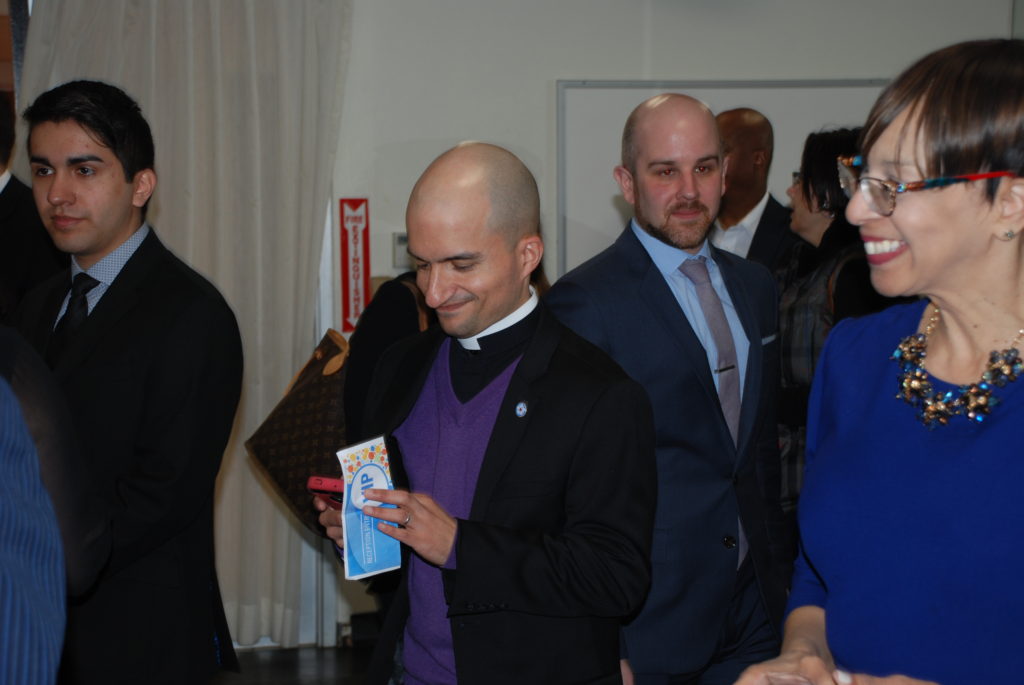
The Adult Choir and Music Director at my church is the NJ State Teacher of the Year. On Sunday she was recognized by Senator Bob Menendez at an event in honor of Evangelina Menendez (the Senator’s mother) and Women’s History Month. I was invited to the VIP reception before the ceremony. It was my first time talking to a sitting US Senator face-to-face.

They also caught me in my natural pose.

Photos provided by the office of Senator Bob Menendez.

Period. A sermon on interpretation and who Jesus sees.

As [Jesus] walked along, he saw a man blind from birth. His disciples asked him, “Rabbi, who sinned, this man or his parents, that he was born blind?” Jesus answered, “Neither this man nor his parents sinned; he was born blind so that God’s works might be revealed in him. We must work the works of him who sent me while it is day; night is coming when no one can work. As long as I am in the world, I am the light of the world.” When he had said this, he spat on the ground and made mud with the saliva and spread the mud on the man’s eyes, saying to him, “Go, wash in the pool of Siloam” (which means Sent). Then he went and washed and came back able to see.

The neighbors and those who had seen him before as a beggar began to ask, “Is this not the man who used to sit and beg?” Some were saying, “It is he.” Others were saying, “No, but it is someone like him.” He kept saying, “I am the man.” But they kept asking him, “Then how were your eyes opened?” He answered, “The man called Jesus made mud, spread it on my eyes, and said to me, ‘Go to Siloam and wash.’ Then I went and washed and received my sight.” They said to him, “Where is he?” He said, “I do not know.”

They brought to the Pharisees the man who had formerly been blind. Now it was a sabbath day when Jesus made the mud and opened his eyes. Then the Pharisees also began to ask him how he had received his sight. He said to them, “He put mud on my eyes. Then I washed, and now I see.” Some of the Pharisees said, “This man is not from God, for he does not observe the sabbath.” But others said, “How can a man who is a sinner perform such signs?” And they were divided. So they said again to the blind man, “What do you say about him? It was your eyes he opened.” He said, “He is a prophet.” The Jews did not believe that he had been blind and had received his sight until they called the parents of the man who had received his sight and asked them, “Is this your son, who you say was born blind? How then does he now see?” His parents answered, “We know that this is our son, and that he was born blind; but we do not know how it is that now he sees, nor do we know who opened his eyes. Ask him; he is of age. He will speak for himself.” His parents said this because they were afraid of the Jews; for the Jews had already agreed that anyone who confessed Jesus to be the Messiah would be put out of the synagogue. Therefore his parents said, “He is of age; ask him.” So for the second time they called the man who had been blind, and they said to him, “Give glory to God! We know that this man is a sinner.” He answered, “I do not know whether he is a sinner. One thing I do know, that though I was blind, now I see.” They said to him, “What did he do to you? How did he open your eyes?” He answered them, “I have told you already, and you would not listen. Why do you want to hear it again? Do you also want to become his disciples?” Then they reviled him, saying, “You are his disciple, but we are disciples of Moses. We know that God has spoken to Moses, but as for this man, we do not know where he comes from.” The man answered, “Here is an astonishing thing! You do not know where he comes from, and yet he opened my eyes. We know that God does not listen to sinners, but he does listen to one who worships him and obeys his will. Never since the world began has it been heard that anyone opened the eyes of a person born blind. If this man were not from God, he could do nothing.” They answered him, “You were born entirely in sins, and are you trying to teach us?” And they drove him out.

Jesus heard that they had driven him out, and when he found him, he said, “Do you believe in the Son of Man?” He answered, “And who is he, sir? Tell me, so that I may believe in him.” Jesus said to him, “You have seen him, and the one speaking with you is he.” He said, “Lord, I believe.” And he worshiped him.

Jesus said, “I came into this world for judgment so that those who do not see may see, and those who do see may become blind.” Some of the Pharisees near him heard this and said to him, “Surely we are not blind, are we?” Jesus said to them, “If you were blind, you would not have sin. But now that you say, ‘We see,’ your sin remains.

John 9:1-41

My sermon from the Fourth Sunday in Lent (March 26, 2017) on John 9:1-41.

Play

A Pastoral Letter Condemning Antisemitism

ELCA Clergy throughout the region composed and signed a joint letter condemning antisemitism. We printed it in our bulletin on March 26, 2017. I drafted the initial letter. My colleagues (including a Jewish Rabbi) refined the language.

In 1994, the Evangelical Lutheran Church in America (ELCA) pledged “to oppose the deadly working of [antisemitism], both within our own circles and in the society around us” (Declaration of ELCA to Jewish Community). Now that our Jewish neighbors have once again become the victims of antisemitic threats and vandalism, we are instructed by our Presiding Bishop of the ELCA, the Rev. Elizabeth A. Eaton, “to speak out, to reach out, to show up, and to root out this deadly bigotry” (Letter to Pastors, dated February 22, 2017).

As Lutheran Christians, we confess our own history of antisemitism. We are implicated in the history of anti-Judaism spanning the history of the Christian faith, and in the memory and heritage of Martin Luther and his “anti-Judaic diatribes and the violent recommendations of his later writings” (Declaration of ELCA to Jewish Community). It is in this spirit of truth telling that we acknowledge our truth while, at the same time, point to the wider truth of God’s love for all of God’s people. The violent invectives of our past should not be the reality of the present or our future. We are inspired by our Christian faith in a God who becomes incarnate and moves closer to us to save us, despite our flaws and sin, and thus free us to move closer to others in fellowship and solidarity. As Christians, we are called to be “ambassadors of hope in the face of despair” (letter dated February 22, 2017) as a faithful response to the love of God in Jesus and to our call to love all our neighbors.

Therefore, we, the undersigned pastors of Lutheran churches of the ELCA, serving or supporting congregations in Bergen, Essex, Morris, Passaic, and Rockland counties, condemn antisemitism in the strongest possible terms. No Jewish person, institution, house of worship, or cemetery should be threatened with hate or violence. Bomb threats directed at over 100 Jewish Community Centers and Day Schools (including Tenafly and Paramus) and the vandalism at Jewish cemeteries in St. Louis, Philadelphia, and Rochester are deplorable acts. The rise in the use of swastikas and other Nazi imagery is abhorrent. Our condemnation of this violence and all antisemitic speech, threats, and actions is unequivocal. We will continue to speak out and confront the evil of antisemitism in our communities. We will stand alongside our Jewish neighbors, institutions, and places of worship. We call upon our elected local, state, and national leaders to repudiate all expressions and acts of antisemitism. We will continue “to work for the end of systemic racism and discrimination” so “all people in our communities, regardless of race, religion, disability, sexual orientation, ethnicity, gender, or gender identity…may flourish” (A Pastoral Post Election Letter from Northern NJ Clergy, dated November 23, 2016).

Signed:

The Rev. Wendy Abrahamson, Pompton Plains
The Rev. Hayley Bang, Paramus
The Rev. Arnd Braun-Storck, Elizabeth
The Rev. Carol Brighton, Ramsey
Deacon Abby Ferjak, Ridgewood
The Rev. Julie Haspel, Oakland
The Rev. Peggy Hayes, Dumont
The Rev. John Holliday, Old Tappan
The Rev. Lisa Holliday, New Milford
The Rev. Michael Linderman, Ramsey
The Rev. Jenny McLellan, Allendale
The Rev. Jeff Miller, Clifton
Vicar Paul Miller, Ramsey
The Rev. Will Moser, Montclair
The Rev. Robert Mountenay, Wayne
The Rev. Peggy Niederer, Teaneck
The Rev. Scott Schantzenbach, Oxford
The Rev. Joseph Schattauer Paillé, Wyckoff
The Rev. Wes Smith, Saddle River
The Rev. Roger Spencer, North Haledon
The Rev. Beate Storck, Tenafly
The Rev. Marc A. Stutzel, Woodcliff Lake
The Rev. Stephen Sweet, River Edge
The Rev. Ignaki Unzaga, Glen Rock
The Rev. J. Lena Warren, Pearl River, NY

Cinderella Story: a reflection on David’s anointing

The First Reading is 1 Samuel 16:1-13.

Today’s first reading is the moment when David appears on the scene. He has 7 older brothers and is watching sheep when Samuel arrives. Samuel is a prophet and is the chief religious figure in the land. When the people of Israel asked for king, Samuel was the one who followed God’s voice and crowned Saul king. But Saul’s kingship went poorly. We never hear the full reason why God turns away from Saul but God does. God stops being present in Saul’s life. Saul grows erratic, violent, and paranoid. When Samuel arrived in Bethlehem, the people did not know what to expect. Did Samuel come as Saul’s messenger to deliver a warning or threat? Samuel came to do something else. He’s came to commit treason and crown (anoint) David as a new king.

One of the key lines in this story is verse 7. We have to remember that the writers of scripture did not understand human anatomy like we do. For them, the heart was the brain-soul-muscle of a person. The heart held memories, created thoughts, was the source of our will and personality. The heart was more than a muscle. The heart was the source of who we are. God is not enticed by height or strength. God is enticed by fidelity and character.

David’s anointing is not a strange story in Scripture. One of the most common storylines used in the Bible is God showing unexpected favor to a younger sibling. David is 8th in line. In a worldview that honored the first born son most, David never should have seen Samuel. But God sees David differently. God valued the least of Jesse’s sons and crowned him king. This story sounds like a Cinderella story (like a 16 seed beating a 1 seed at the start of March Madness). Yet David’s happily-ever-after is not the happily-ever-after we hope for. He will compete with Saul for years. He will create a large kingdom. He will take Bathsheba, a woman who is married to one of his soldiers, against her will. His kingdom will be rocked and torn apart by scandal. And he will lose family and friends in coup attempts and wars. David is chosen by God but the path he follows is full of dangers, hardships, joys, and failures

Each week, I write a reflection on one of our scripture readings for the week. This is from Christ Lutheran Church’s Worship Bulletin for 4th Sunday in Lent, 3/26/2017.

What to Keep? From Pastor Marc – My Message for the Messenger, April 2017 Edition

I feel like I’ve been “spring cleaning” for months now. In mid-February, when the temperature warmed up, I felt the urge to tidy up. I started looking at my clothes differently. I wondered if I really needed all these books on my bookshelf. I stared at the toys scattered in every room in my house and wondered if my kids would notice if they were gone. When the cold of winter breaks, throwing things out is what I want to do.

But what if spring cleaning was more about what we kept rather than what we threw away? Instead of focusing on the clutter, we spend time looking at what we have. The shirt we love ‘tis worth more than the trendy shirt we never wore. The chalkboard that lets kids imagine new worlds is more important than the unplayed matchbox cars surrounding it. When we focus on what to keep, our perspective changes. We stop grabbing everything we can because each item we buy is invited into an environment where it will be used, cherished and appreciated. The world we live in becomes a little more intentional because keeping things is a very intentional act.
That first Easter morning was a very intentional act. When Jesus was crucified on Good Friday, he was being thrown away. The Roman Empire didn’t know what to do with this rabble rousing rabbi from the backwaters of Galilee so they removed him from the scene. When he was placed in the tomb, his story was supposed to be sealed up for good. But Jesus’ story wasn’t over. The next morning, women came to the tomb to finish the rituals of burying their beloved teacher. They found Jesus’ tomb empty because the Resurrection means nothing, not even death, can keep Jesus away from us.

This Easter, I invite you to think about what you keep in your life. Bring what you don’t keep to church as we prepare for our annual Trash & Treasure Sale. And then celebrate the relationship you have with a God who promises always to keep you.

See you in church!
Pastor Marc

Get Me a Drink: a sermon on sharing even when you don’t know the full story.

[Jesus] came to a Samaritan city called Sychar, near the plot of ground that Jacob had given to his son Joseph. Jacob’s well was there, and Jesus, tired out by his journey, was sitting by the well. It was about noon.

A Samaritan woman came to draw water, and Jesus said to her, ‘Give me a drink’. (His disciples had gone to the city to buy food.) The Samaritan woman said to him, ‘How is it that you, a Jew, ask a drink of me, a woman of Samaria?’ (Jews do not share things in common with Samaritans.) Jesus answered her, ‘If you knew the gift of God, and who it is that is saying to you, “Give me a drink”, you would have asked him, and he would have given you living water.’ The woman said to him, ‘Sir, you have no bucket, and the well is deep. Where do you get that living water? Are you greater than our ancestor Jacob, who gave us the well, and with his sons and his flocks drank from it?’ Jesus said to her, ‘Everyone who drinks of this water will be thirsty again, but those who drink of the water that I will give them will never be thirsty. The water that I will give will become in them a spring of water gushing up to eternal life.’ The woman said to him, ‘Sir, give me this water, so that I may never be thirsty or have to keep coming here to draw water.’

Jesus said to her, ‘Go, call your husband, and come back.’ The woman answered him, ‘I have no husband.’ Jesus said to her, ‘You are right in saying, “I have no husband”; for you have had five husbands, and the one you have now is not your husband. What you have said is true!’ The woman said to him, ‘Sir, I see that you are a prophet. Our ancestors worshipped on this mountain, but you say that the place where people must worship is in Jerusalem.’ Jesus said to her, ‘Woman, believe me, the hour is coming when you will worship the Father neither on this mountain nor in Jerusalem. You worship what you do not know; we worship what we know, for salvation is from the Jews. But the hour is coming, and is now here, when the true worshippers will worship the Father in spirit and truth, for the Father seeks such as these to worship him. God is spirit, and those who worship him must worship in spirit and truth.’ The woman said to him, ‘I know that Messiah is coming’ (who is called Christ). ‘When he comes, he will proclaim all things to us.’ Jesus said to her, ‘I am he, the one who is speaking to you.’

Just then his disciples came. They were astonished that he was speaking with a woman, but no one said, ‘What do you want?’ or, ‘Why are you speaking with her?’ Then the woman left her water-jar and went back to the city. She said to the people, ‘Come and see a man who told me everything I have ever done! He cannot be the Messiah, can he?’ They left the city and were on their way to him.

Meanwhile the disciples were urging him, ‘Rabbi, eat something.’ But he said to them, ‘I have food to eat that you do not know about.’ So the disciples said to one another, ‘Surely no one has brought him something to eat?’ Jesus said to them, ‘My food is to do the will of him who sent me and to complete his work. Do you not say, “Four months more, then comes the harvest”? But I tell you, look around you, and see how the fields are ripe for harvesting. The reaper is already receiving wages and is gathering fruit for eternal life, so that sower and reaper may rejoice together. For here the saying holds true, “One sows and another reaps.” I sent you to reap that for which you did not labour. Others have labored, and you have entered into their labour.’

Many Samaritans from that city believed in him because of the woman’s testimony, ‘He told me everything I have ever done.’ So when the Samaritans came to him, they asked him to stay with them; and he stayed there for two days. And many more believed because of his word. They said to the woman, ‘It is no longer because of what you said that we believe, for we have heard for ourselves, and we know that this is truly the Savior of the world.’

John 4:5-42

My sermon from the Third Sunday in Lent (March 19, 2017) on John 4:5-41.

*****

Today, right at this moment, what are you grateful for? For me, I’m grateful for parentheses. Now this isn’t the typical thing people share when we talk about being thankful. We usually hear words about our health, or having a roof over our heads, or being thankful for even waking up this morning. Points of punctuation are not usually on the list. But after a week of still not being used to last Sunday’s time change, a storm that kept my kids home from school for two long and loud days, and as we catch our breath after hearing this long text from John right before we move into a moment of prayer and anointing, I’m drawn to those rounded brackets that creates pauses for afterthoughts and explanations. These parentheses break up the story, inviting us to slow down, breathe, and gain a tiny bit of insight while the story of Jesus and the Samaritan woman unfolds. Each set of rounded brackets invites us to stop reading the story and instead just experience it. There is a vast amount of meaning that shows itself when we let ourselves be overwhelmed by this visual, sensual, and dramatic story. But on days when that sounds like a lot of work, and a good nap is more enticing to us than trying to learn everything we can about one of Jesus’ stories, I’m thankful for parentheses because they also show us that the people who first heard these stories, collected them, and shared what Jesus said – even they had off days. Even they didn’t understand all the allusions and details of every story that Jesus showed them. Even these first believers still needed explanations. The parentheses in today’s text reminds us of the grace God gives us to share and tell Jesus’ story even if we are tired, worn out, or let our lack of knowledge keep us silent. 

Now, there’s a lot about this story that didn’t need to be explained to John’s community. They knew the significance of wells, especially Jacob’s well. Wells were not just places to fill your pails with water. Wells, in the Old Testament, were places where love happened. Jacob, the one who wrestled with an angel and was renamed Israel, met his first wife Rachel – at a well. In Jesus’ time, if there were top 40 radio stations, every song wouldn’t have been about hitting the club; it would have been about hanging out at the well. So Jesus, who is single, begins this story by hanging out in the stereotypical place where people meet, fall in love, and get married. And then a woman enters the scene. 

But she comes to the well at a very odd time. John’s community knew visited wells in the morning. They would fill their containers with the water they needed for the day while the air was still cool. But this woman comes at noon, in the middle of the day, when the day would be hot andno one else would be around. The scene is set for both Jesus and the Samaritan woman to be at the place where love happens, by themselves. This story begins with the best setup possible for the biblical version of a Rom Com. 

And that’s not all John’s community would have known. Christian tradition has spent a lot of time focusing on the woman’s marital state, using her history of husbands as a way to judge her character. But as a woman she had limited access to any hope for financial independence. She didn’t have we own wealth, the jobs available to her we’re limited, and she could be divorced by anyone just…cuz. She couldn’t pull herself up by her bootstraps because society wouldn’t let her. Her father, her husband, and her son were they only safety net she had.  We tend to imagine that her five husbands died but it’s more likely they divorced her because she couldn’t have children. And we see that because, after her fifth marriage, she ends up with another man rather than moving into her son’s or her father’s house. She’s a woman who married because she’s trying to survive. If her story had parentheses, it would be filled with the long story of women just trying to make it one more day. I imagine she goes to the well at noon, tired, exhausted, worn out and hoping she won’t see anyone. But Jesus is there, already waiting for her. 

And they talk. And talk. And talk. Jesus knows who she is and invites her to know him. He accepted who she is and the fullness of her story. Jesus offers her, a Samaritan, a foreigner and an enemy, the opportunity to know a God who values, honors, and cares for her. She doesn’t know everything about Jesus but she knows he knows her. And that’s enough for her to leave her bucket behind and go tell others about this man at the well. 

When the Samaritan woman leaves to invite others to get to know Jesus, she doesn’t know all of Jesus’ story. The Cross and the Resurrection are still to come. But her experience of Jesus is honest, authentic, and real because Jesus treats her as honest, authentic, and real too. She goes to invite others to meet Jesus because her experience of being valued by him is something others should experience too. 

The Samaritan woman didn’t know everything before she shared Jesus. And the community John’s gospel came out of didn’t know everything either. Even they needed the conflict between Samaritans and Jews explained. But not knowing the full story doesn’t mean we can’t share our Jesus’ story. The empty parentheses didn’t stop John’s community from sharing Jesus. And the parentheses you carry, the tidbits and explanation you are waiting to be filled, they don’t limit what you can do. Even the doubt and questions you carry, thinking you don’t know enough to really explain this Jesus thing to your family, friends, and neighbors, none of that limits you from sharing what you do you have. You have Jesus. You have a God who promises to be with you even when you want to stay away from prying eyes. You have a story the world needs to hear and you have a faith that truly makes a difference. No parentheses you want filled can change how much God values you. By sharing your honest, authentic, and real faith – no matter how big, or colorful, or full of questions and doubts your faith might have – you’ll show that Jesus is interested in all kinds of people because every person means everything to him. 

Amen.

Play