Now What? Our Spiritual Gifts are life-giving mysteries

I therefore, the prisoner in the Lord, beg you to lead a life worthy of the calling to which you have been called,

with all humility and gentleness, with patience, bearing with one another in love, making every effort to maintain the unity of the Spirit in the bond of peace. There is one body and one Spirit, just as you were called to the one hope of your calling, one Lord, one faith, one baptism, one God and Father of all, who is above all and through all and in all. But each of us was given grace according to the measure of Christ’s gift. Therefore it is said, “When he ascended on high he made captivity itself a captive; he gave gifts to his people.” (When it says, “He ascended,” what does it mean but that he had also descended into the lower parts of the earth? He who descended is the same one who ascended far above all the heavens, so that he might fill all things.) The gifts he gave were that some would be apostles, some prophets, some evangelists, some pastors and teachers, to equip the saints for the work of ministry, for building up the body of Christ, until all of us come to the unity of the faith and of the knowledge of the Son of God, to maturity, to the measure of the full stature of Christ. We must no longer be children, tossed to and fro and blown about by every wind of doctrine, by people’s trickery, by their craftiness in deceitful scheming. But speaking the truth in love, we must grow up in every way into him who is the head, into Christ, from whom the whole body, joined and knit together by every ligament with which it is equipped, as each part is working properly, promotes the body’s growth in building itself up in love.

Ephesians 4:1-16

My sermon from the 11th Sunday after Pentecost (August 5, 2018) on Ephesians 4:1-16. Listen to the recording at the bottom of the page or read my manuscript below.

****************************

So if you are a fan of the Internet, your social media feeds might have been devoted to goats over the last few days. A goat on the internet can mean many different things. It can be an acronym, referring to someone who is a g o a t – the greatest of all time. But it can also refer to that hairy little animal with horns that eats practically everything. On Friday morning, a breaking news report shook Boise, Idaho because over 100 goats were wandering in a residential area. At first, no one knew how they got there. They just showed up, wandering from yard to yard. Now, if your yard is mostly crabgrass like mine is, a bunch of goats coming over to have lunch isn’t really that scary. But if you have a yard you actually care for, a herd of goats showing up at your front door is downright terrifying. Those goats were on a mission and they were going to eat every plant in sight.

Now, if you followed the story, you know how the goats got there and what happened next. Everything, eventually, worked out and the goats went back to where they came from. It’s a fun little news story with a happy ending but instead of focusing on how the story ended, I want to spend time with how the story began. And it started with a tweet. Joe Parris, a reporter for a tv station in Boise, received a tip about these goats, so he went out and found them, taking 4 pictures of the goats with his phone. He immediately sent word to the wider internet that by writing this: “#Breaking – About 100 goats are on the loose right now in a Boise neighborhood. They are going house to house eating everything in sight. Nobody has a clue where they came from…updates to follow.” Goats on the loose is a really great sentence we don’t hear often. And this short news tweet had everything in it to keep us interested. But what drew me into this story wasn’t only the goats. Rather, what enticed me was how no one knew how they got there. It was a mystery! And the very best kind of mystery there is. If imagine ourselves as one of the homeowners on that street, seeing one goat in our front yard would be unexpected. But seeing over 100 goats would totally blow our mind. We would wonder where they came from but that question would have to wait because the mysterious herd of goats would be making our flower and vegetable beds disappear in a very non-mysterious way. We wouldn’t get to dwell on where this mystery came from. Instead, we have to live with it, and engage it, right away. And that’s what makes mysteries powerful. A mystery is an experience we can’t, in that moment, fully explain but it is something we have to live through. We run into these kinds of mysteries all the time and they’re usually very small. We might get a phone call late at night from an unlisted number and wonder who called us. But when that person leaves a voicemail, that little mystery is solved. Yet there are other mysteries that we are asked to hold onto; mysteries we can’t fully explain. And that’s important because it’s those mysteries that teach us who God is calling us to be.

We have spent these last few weeks taking time during worship to explore our spiritual gifts. And we’ve done that because of this passage from our second reading today. This is the moment in Ephesians when the focus of the letter changes. Before this, the author talked about everything that God had done and how God, through Jesus, had included Gentiles into a new humanity God was bringing about. This new humanity isn’t here yet so God created a community of faith, a church, that could be a inclusive, welcoming, and loving community for us all. God gives the church a sense of unity by connecting us to each other through the gift of faith and the gift of baptism. But this unity doesn’t ask us to forget who we are. We all have our own histories, backgrounds, experiences, and identities. We are all different. And that’s great because God wants the church to include all the diversity present in God’s world. Living with this kind of diversity isn’t always easy. So the letter to the Ephesians moves away from talking about what God has done and invites us to consider how our lives can respond to God done. And one way we do this is by discovering the gifts God has given to each of us.

These gifts, our talents and abilities, are not always easy to see. And, in fact, they can be quite mysterious. A gift we use in our everyday life might not be the gift God wants us to use in the church. We might be an amazing public speaker, able to articulate a clear point of view that impresses our coworkers and our boss. Yet in the church, God might want us to hold back, to not speak out as much as we do, and instead nurture a prayer life that prays for everyone in our bulletin and in our prayer chain. Or this mystery could be the exact opposite. We might be shy when we’re out in public and at school. We might be unassuming and quiet when we’re part of a large crowd. Yet in this place, surrounded by people who recognize us as a necessary part of what God is doing in the world, the spiritual gift of preaching might be exactly what God wants us to do. We can’t assume that the gifts we use in the world are the same gifts God calls us to use inside the church. Because the spiritual gifts God gives to each of us are designed for one thing: and that’s to help all of us grow into the kind of people God wants us to be. That happens when we, as a community, know each other and know ourselves. The gifts we bring into the church are needed so that the people sitting next to us can become the Christians they’re meant to be. And their gifts other people have are necessary for us so that we can fully follow Jesus Christ. These mysterious gifts from God are not designed to remain a mystery to those around us. We need to tell each other our stories and share the gifts God has given us. We need to listen to each other so that we can discover who we are and how other people’s gifts can change our lives. And we need to recognize the gifts we see in others before they see it in themselves. Our spiritual gifts, right now, might be mystery. Or we might think that we don’t have any gifts to share at all. But if 100 goats can show up mysteriously in Boise, Idaho, then we can take a chance and live more deeply into the mysteries of faith, love, hope, and mercy that God gives to us each and everyday. It’s in those mysteries where we discover who God is and why Jesus makes a difference in our lives. And it’s through those mysteries where we learn how we can make a difference in Christ’s Church and throughout all of God’s world.

Amen.

Play

In the news: Churches mark 500th anniversary of Protestant Reformation

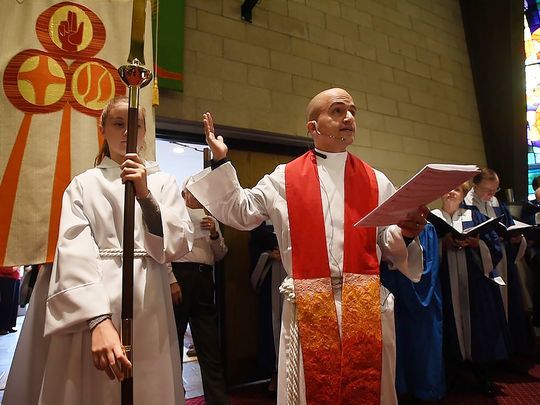
This is a copy of a news article I appeared in on October 30, 2017.. It celebrates a joint worship service with First Congregational in Park Ridge, Christ Lutheran Church, and Pascack Reformed Church to honor the 500th Anniversary of the Reformation. My picture appeared on the cover of the local section in the Record. Article by Michael W. Curley, Jr. Photo by Mitsu Yasukawa. Includes video!

Luther’s break from the Catholic Church started the Protestant movement as others followed suit, resulting in numerous denominations splitting from what was at the time the only Christian church.

The various denominations of Christianity are still related after the Reformation, often referred to as a schism within the church, Stutzel said. Even though they each approach their faith differently, he said, the denominations are more similar than they are different.

“Over the last 200 years or so, the Lutherans in this country, mostly, not all of us, have had experiences where we’ve started joining together instead of splitting apart. We’ve been really acting on joining together,” he said. “There’s a movement to celebrate what’s common to us.”

As different faiths have often used arguments on faith to remain separate, Sunday represented “something strange,” Stutzel said, likening the shared service to Luther’s habit of inviting many different people to his home for dinner to talk with them.

“We’re a united and uniting church,” Suriano said. “So we’re very interested in joining together with other churches from the inception of our denomination.”

The pastors said they have been working toward bringing their congregations together since they each came to their churches in the last three years, including a joint Cross Walk around Easter.

They decided to make events out of the fifth Sunday of a month into special events, and with Reformation Sunday and the 500th anniversary of the Reformation falling on a fifth Sunday, it made an obvious choice to kick off the practice.

“Our motto is, ‘reformed and always reforming,’ so we’re always looking for new ways to connect, have a relationship with God, a relationship with others,” Romero said. “We think that we can still be together and connected in all the ways that we have in common.”

The Seed of it All: forgetting and remembering

Now the eleven disciples went to Galilee, to the mountain to which Jesus had directed them. When they saw him, they worshiped him; but some doubted. And Jesus came and said to them, “All authority in heaven and on earth has been given to me. Go therefore and make disciples of all nations, baptizing them in the name of the Father and of the Son and of the Holy Spirit, and teaching them to obey everything that I have commanded you. And remember, I am with you always, to the end of the age.”

Matthew 28:16-20

My sermon from Trinity Sunday (June 11, 2017) on Matthew 28:16-20. Listen to the recording at the bottom of the page or read my manuscript below.

****************************

What’s the last thing you forgot? I…don’t remember. I’m sure, if you asked my kids or my spouse or checked my email inbox which is my default to-do list, I’m sure you’d find the last thing I forgot to do. But when we frame forgetting in this way, we make forgetting seem like it’s only about a promise we broke or it’s something that happened when the busyness of life got in our way. But forgetting is more than that. Forgetting can feel like we’ve lost something. This week I stumbled on an article from the New Yorker written by Kathryn Schulz with the title “When Things Go Missing.” It’s an essay that starts in Portland in the summer when suddenly, according to Kathryn, everything “fell out of place.” She writes:

My first day in town, I left the keys to [my] truck on the counter of a coffee shop. The next day, I left the keys to the house in the front door. A few days after that, warming up in the midday sun at an outdoor café, I took off the long-sleeved shirt I’d been wearing, only to leave it hanging over the back of the chair when I headed home. When I returned to claim it, I discovered that I’d left my wallet behind as well….later that afternoon I stopped by a sporting-goods store to buy a lock for my new bike and left my wallet sitting next to the cash register. I got the wallet back, but the next day I lost the bike lock. I’d just arrived home and removed it from its packaging when my phone rang; I stepped away to take the call, and when I returned, some time later, the lock had vanished. This was annoying, because I was planning to bike downtown that evening, to attend an event at Powell’s, Portland’s famous bookstore. Eventually, having spent an absurd amount of time looking for the lock and failing to find it, I gave up and drove the truck downtown instead. I parked, went to the event, hung around talking for a while afterward, browsed the bookshelves, walked outside into a lovely summer evening, and could not find the truck anywhere.

Even on our best days, we’re forgetting something. One insurance company claims that we misplace nine objects every single day. That means, by the time [we’re] [Marcus is] sixty, [we’ll] [he’ll] have lost up to two hundred thousand things. Now, we mostly find the things we lose. But looking for things takes time. When you add up all the time we will spend in our lives looking for things we’ve lost, we’ll spent almost six months looking for our keys and wallets. We’re good at losing things because we’re good at forgetting. But we shouldn’t limit forgetting to just losing things. Forgetting can also be heartbreaking. I’ve witnessed an illness causing someone to forget their own name. I’ve been at the bedside of people who forgot how to speak English and instead, started speaking Spanish and Swedish and all these other languages they hadn’t spoken since they were six. Many of us have parents or siblings or loved ones who have forgotten who we are and who, at the same time, seem to have lost who they are too. Forgetting can be as simple as asking a friend to call our cell-phone because we have no idea where it is in our house. And forgetting can be as terrifying as losing who we are.

Which is why I struggle with our translation of Jesus’ last words in the gospel according to Matthew today. Jesus, after his death on the cross, after his resurrection, and after he has spent time showing his followers that the brokenness of this world is not the final chapter God has planned for us, Jesus makes one more public statement. He gathers his friends on a mountain top because, in Matthew, that’s where important things happen. Some of his followers are excited to be there. Others…don’t really know what’s going on. Even though Jesus is right in front of them, some of his friends doubt. But Jesus pulls them all together because he has one more thing to say. In a few short sentences, Jesus explains who he is. Jesus gives his followers a list of things to do. And then he ends on a word of promise, a promise that our translation today begins with the words: “And remember…”

Now, there is something powerful about remembering, especially during difficult times. When life is hard, we can remember that Jesus lived and died for you not because you are perfect but because Jesus loves you. Jesus is there with you while your heart breaks because his heart is breaking too. That’s… who Jesus is. But the words, “And remember…” can also be a tad terrifying because it seems as if Jesus is giving us a task to do that we’re not always cut out for. I mean, I have literally forgotten where I have put my shoes. And I have sent texts to my spouse, telling her to bring the plastic collar I wear around my neck, this collar that signifies my role as a pastor, because…I forgot it and left it at home. Jesus is asking an awful lot of us when he asks us to remember because there are times when we won’t. There are times when we can’t. And there are times when we’re experiencing so much joy and so much sadness that Jesus will be the last thing on our minds. When we take a step back and look at our entire life of faith, it’s easier to talk about what we’ve lost rather than what we remember because losses linger. Loved ones die. Friends move away. Relationships end. We lose our jobs, our sense of stability, and our bodies no longer work the way they use to as we get older, ill, and frail. As Kathryn Schulz writes further in her article, “We lose things because we are flawed; because we are human; because we have things to lose.” I’m not sure Jesus should rely on our ability to remember because forgetting and loss is sometimes all we have.

But I don’t think that’s what Jesus is doing in these last verses from Matthew. The Greek word that our translation translates as “Remember…” isn’t usually used in that way. Instead, it’s an interjection. It’s a shout. It’s the same word that announces the sudden appearance of an angel and lets us know that Jesus’ friends freaked out when the prophets Moses and Elijah showed up on a mountain. The word really means “Look! See! Hey, over here!” It’s pointing out something that is sudden, exciting, and totally unexpected. It’s a word to that let’s us know that whatever follows it, matters. Jesus doesn’t order his disciples to remember his promises, as if our actions can somehow make these promises true or not. Instead, Jesus is saying: “look! I am with you. I will be with you. And you cannot lose me like you will lose your car keys…or even your memory.” Once God knows us, we cannot stop God from coming to us. Once Jesus claims us in our baptism, we can’t ever stop him from loving us. Our faith and the relationship God has with each of us is too important for God to leave up only to us. Instead, God takes the initiative to claim us, to hold us, and to live with us because God says we are worth more than we will ever know. Our relationship with God doesn’t depend or being with something that we do or rely on whether we can remember who God is. Our relationship depends only on the promises God gives to us – a promise made real in the gift of faith itself. This faith moves us, this faith transforms us, this faith pushes us into the promise Jesus makes here. “Look! See! Hey, this is important.” No matter where we are, or what we do, or where we go – Jesus promises that little Marcus and all of us will never be alone.

Amen.

Play

Sermon: Just a Kiss

Six days before the Passover Jesus came to Bethany, the home of Lazarus, whom he had raised from the dead. There they gave a dinner for him. Martha served, and Lazarus was one of those at the table with him. Mary took a pound of costly perfume made of pure nard, anointed Jesus’ feet, and wiped them with her hair. The house was filled with the fragrance of the perfume. But Judas Iscariot, one of his disciples (the one who was about to betray him), said, “Why was this perfume not sold for three hundred denarii and the money given to the poor?” (He said this not because he cared about the poor, but because he was a thief; he kept the common purse and used to steal what was put into it.) Jesus said, “Leave her alone. She bought it so that she might keep it for the day of my burial. You always have the poor with you, but you do not always have me.”

John 12:1-8

My sermon from the Fifth Sunday in Lent (March 13, 2016) on John 12:1-8 and Deuteronomy 34.

******

Since January 1st, we’ve read and heard many different stories from the first five books of the bible. We’ve seen creation, met Abraham, watched Jacob wrestle an angel, and watched as Moses led the people out of slavery. All of this has led to today’s first reading – the final chapter of Deuteronomy. The Israelites are camped on the east bank of the Jordan, ready to enter the land promised to Abraham and to them. After 40 years in the wilderness, they’re finally ready to build a home. But before they can take that next, Moses, their fearless and devoted leader, must do something first. He needs to say goodbye. 

Now, this moment can’t be easy for Moses. Even though Moses, way back in Exodus, begged God to send someone else in his place, he’s now just a hop-skip-and-a-jump from his goal, ever since he left Egypt those many years ago. For over a generation, he’s talked with God, shared God’s word, and negotiated with God and the people even when both sides seemed to turn their backs on each other. Moses has done all he can to prepare the people, to prepare the Israelites, for life after slavery. But even Moses isn’t perfect. Moses, whose face shined after he spoke to God – even he disobeys. His anger and frustration get the better of him. While in the wilderness, when the people complained that they had no water, Moses lashes out and fails to follow God’s word exactly. And so, Moses knows that he’s not going to enter the promised land. Instead, he’s going to take the people to the cusp – to the east bank of the Jordan River – and tell everyone all he can about God’s word and God’s story. But it’s time for Moses to move the nation along. It’s time for the Israelites to outlive Moses once he’s gone. So Moses, his mission complete, climbs up a mountain. He climbs to the top, looks out, and sees everything. He sees all that God promised – to the north and to the south, and he can see the blue tint of the Mediterranean Sea on the horizon. Moses sees everything – and then, “at the Lord’s command,” he dies. 

Now, that phrase, “at the Lord’s command,” is a little different in the ancient Hebrew. The phrase is literally “by the mouth of God.” It’s not a word or phrase that God uses to kill Moses. It’s…God’s mouth. We don’t actually know how this death happens. But there’s an old legend that saw these words and imagines that the close, intimate relationship God had with Moses extends even into death. So God does use the mouth to take Moses. God takes Moses…with a kiss. 

God taking Moses with a kiss seems a little silly…except we know that kisses are powerful things. Kisses are intimate. They’re personal. Kisses are more than little bits of chocolate in the form of a bell. They’re a sign of relationships. Think for a moment, about that first special kiss – and even if we haven’t had that kind of kiss yet, we still know it matters. We know it’s special. Even on a tv show like the Bachelor, where two dozen women will have their first-kiss with this season’s Bachelor broadcast on national tv while they compete for the Bachelor’s engagement ring – even in this assembly line of first-kisses, we know those kisses are still important. Their first kiss, even when it’s surrounded by other first kisses, even when we roll our eyes at all the first kissing we see going on, we know, in our gut, that their first kiss symbolizes their relationship to each other. That kiss is a symbol of their possible future, their exciting present, and their hope that this commitment to each other is more than fleeting and for more than just tv ratings. We know that kisses matter because a kiss can be more than just a kiss. A kiss can show love. 

Last week, I co-led a small conversation at the River Vale Public Library on the topic of holy living. My two co-presenters, Rabbi Geary Friedman and Rabbi Deborah Orenstein, and I each took a different area of life and hinted at what holy living looks like through our time, our places, our jobs, and even our bodies. Afterwards, as I reflected on the event, I was struck me how each of us started from a similar place. We all started our exploration of holy living by answering who, and whose, we are. Living a holy life, a godly life, starts with our capacity to be with God – our capacity to be holy. And this capacity, for Christians at least, doesn’t depend on our goodness. It doesn’t depend on how perfect we are, how often we pray, or how many times we actually make it to church. Our capacity for holiness depends entirely on this God who claims us as God’s own. God doesn’t wait for us to be perfect before God makes us holy. God comes to us first, in our baptism, to hold us. So, when I got to this part of my presentation last week, I shared one of my favorite images for baptism. It begins by imaging God far away, living up in heaven. God’s there, among the clouds, sitting on a throne, with angels and saints doing what it is that angels and saints do. But, in the business of overseeing the entire universe, God looks down. God squints. God sees us – sees you – and sees me – circling on this 3rd planet from the Sun. And then God steps off the throne. God rushes down to us as we are, a baby, a child, even an adult – and God baptizes us with a kiss saying “you are mine.” With a kiss we are claimed. With a kiss, we’re brought into God’s realm. And with a kiss of water, we’re baptized into a relationship we did nothing to earn. With a kiss and a cross, God is ours and we become God’s.

It’s a kiss that starts the relationship – and, in Moses’ case, a kiss that seems to end it. But we know it doesn’t. God picked Moses for a reason. And Moses kept his eye on God for a reason too. Even after Moses broke God’s word, God still told Moses to teach the people. God continued to use Moses to lead the people forward. And even though Moses knew he would never, ever, enter the promised land, Moses didn’t turn his back on God. He kept teaching, praying, and sharing God with everyone he met. God was committed to Moses and Moses was committed to God. Moses came to the edge of the promised land – and he died like he lived, in a full, personal, and committed relationship with the God who claimed him. Once God had Moses, not even death could separate them. 

So how would our lives look if we dug deep into God’s kiss? What, if anything, would be different? 

If I’m honest, I really don’t know the answer to those questions. Whatever answer I prayerfully come up with is going to fit my life, my relationships, and my responsibilities. And I also know that my answers today won’t necessarily match what I might say two or three years from now. Life moves quickly. Situations we never expected can show up on our doorsteps. And time is always moving forward – even if we sometimes feel we’re standing still or taking way too many steps back. As we journey through our own challenges, and through our own wilderness, we don’t always know where we’ll end up. All we know is that things do change – but God’s presence doesn’t. God’s relationship continues. God’s kiss is never ending. God’s kiss is always about starting a new beginning. We might not be Moses but we can be who God is calling us to be. Let’s live into God’s love. Let’s look out and see all that God has promised. Let’s move forward even if we don’t know if we’ll ever see a world of love and peace and hope that God desires for everyone. Let’s live into God’s kiss – right now – and discover just what kind of life we can give to the world. 

Amen.

More than Two Weeks

Chula, late September 2015

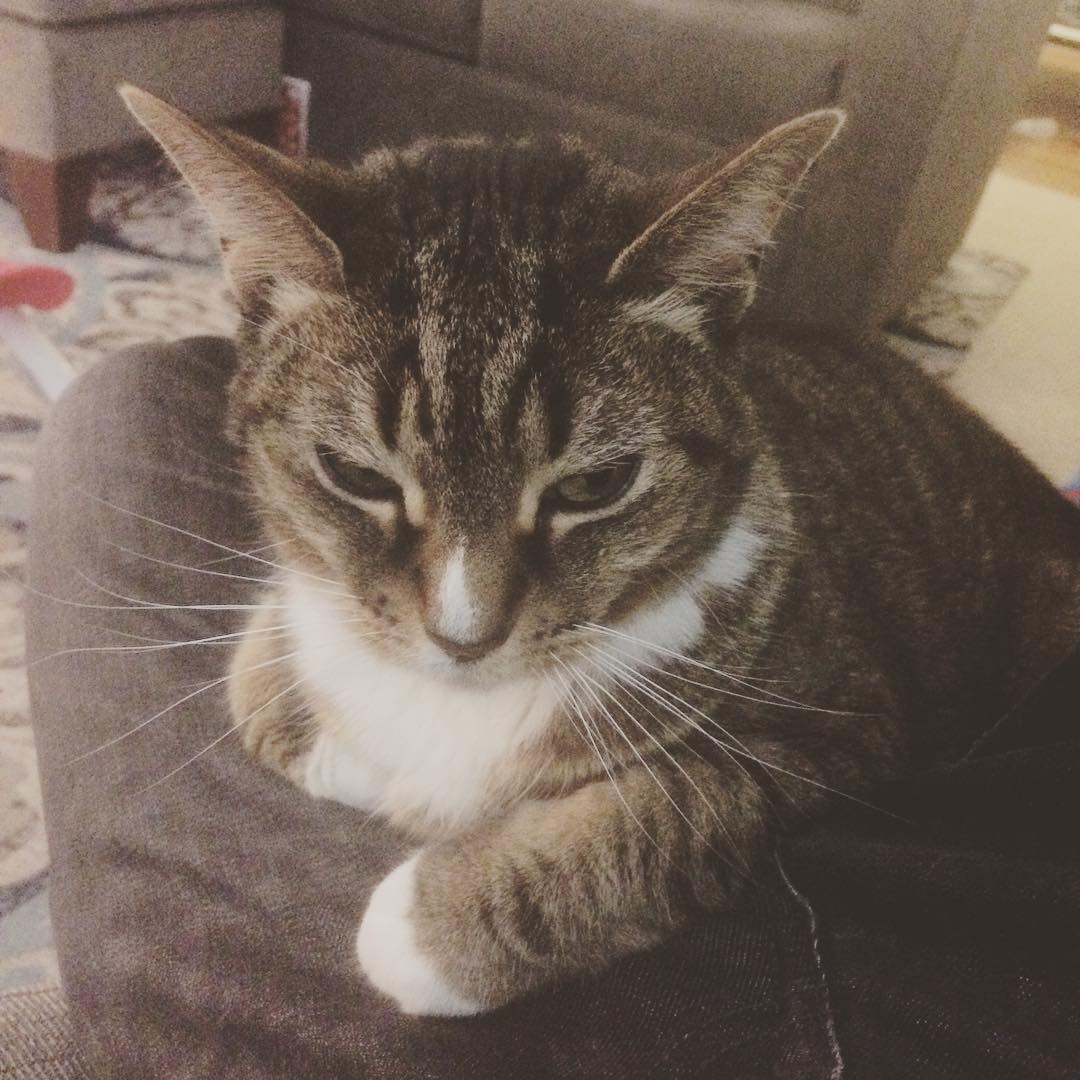
It was the day after Columbus Day when I noticed that our home didn’t seem right. As I was getting my kids ready for school, I wandered the house opening closet doors and checking under beds. I checked all the usual spots but I still couldn’t find her. Chula, our cat, is missing.

We believe she snuck out the night before, when we returned home from an evening out. In the transition from inside to outside, the door was left open and she snuck out. She’s only done this once before and it wasn’t for very long. But this time was different. She didn’t come back. We made flyers, put out food, and walked the neighborhood calling her name. We’ve visited the local animal shelters and alerted all the vets and cat rescues in the area. We even turned my iPod touch into a security camera to keep watch during the night. So far, there’s been one probable sighting by our mailmen and we heard cats (possibly) fighting on our front stoop. But that’s it. The food is being eaten by local cats and raccoons. The weather is turning cold and wet. We’ve run out of options and are just waiting to see if she’ll come back.

It’s maddening. Every time I walk by the front door, I look out to see if she’s there. If I can sneak home in between pastoral visits, I stop by to see if she’s sunning on the back porch. I keep hoping for a glimpse.

While this goes on, of course, life goes on as well. There are still kids to get to school, Halloween costumes to order, sermons to preach, and worship services to craft. Life doesn’t stop but it feels different since Chula isn’t there like she use to be. We’ve gone from two lovable pets to zero in a very short time. Let’s see if, by just writing this and putting it out in the atmosphere, maybe she’ll come back from her adventure tonight.

A reflection on Acts 3: who is in and who is out

Today’s first reading is from Acts 3:12-19.

Today’s first reading is a step back in our journey through Acts this Easter season. Last week, we were in chapter 4. Right now, we’re in chapter 3. The disciples are in Jerusalem when Peter and John go to pray in the Temple. While there, Peter sees a man who has never walked and heals him in the name of Jesus. The man leaps and jumps praising God, and clinging to Peter and John in thanksgiving for healing. People are surprised, confused, and wondering what just happened. So Peter responds with our reading today.

One of the core elements in today’s reading is what it means to be part of God’s family. Peter’s words emphasize two things: how God continues to expand who is in Jesus’ group and who isn’t. Now, this can get very dicey and appear to be very black and white. Peter could use this opportunity to reject those who are gathered in the Temple. Even though they share the same identity as Jews, the people at the temple responded to Jesus differently. The disciples proclaim that Jesus is the Messiah while the rest do not. That’s the boundary between who is part of Jesus’ group and who isn’t. Peter could look at those gathered around and reject them. He could say that they rejected Jesus and, in a sense, killed him along with the Roman authorities. Peter could wash his hands of them, condemn them, and say that they have no hope in ever being part of God’s true family.

But Peter doesn’t. Instead, he invites them in because being part of God’s in-group is open to all.

We’ll always struggle with who is “in,” and who is “out.” But God continues to push us to open the group by inviting people into a relationship with Jesus and with us. There’s a risk when we do that. The people who might accept our invitation might not be like us. They might do things differently, enjoy different activities, or speak different languages. They might not even look like us. The ones we invite might change the group and make it different from what it was before. And that’s scary. But that’s God’s call. God’s love invites relationship and communion with everyone. God’s love invites us to grow and change. Peter invited those around him into Jesus’ family, knowingly inviting them to join the Body of Christ and making it shine with the love of God that encompasses all.

Each week, I write a reflection on one of our scripture readings for the week. This is from Christ Lutheran Church’s Worship Bulletin for 4/19/2015.

Columbus Circle and Me

Castrol Oil is having a contest giving away 2 Super bowl tickets each day for ten days. The rules require you to take a selfie at 1 of 3 locations that are revealed each morning. The rules are not clear on what actually is an entry (whether each person is allowed 1 selfie or if each posted selfie is an entry or if each post is an entry – even if the selfie was posted previously). After it appeared that multiple submissions of the same picture seem to be allowed (and this strategy might have worked for one of the winners), I was inspired to take this contest to another level. But I didn’t want to post just one photo a million times. Oh no. Instead, I decided to have some fun. One of today’s locations was Columbus Circle. Castrol’s contest inspired me to take over 250 different selfies. My self-facing camera on my iPod touch doesn’t work so it was a tad difficult to take all these pictures. However, I’ve slowly uploaded them to my social media sites all day because, in the end, this .gif is what I wanted to create.

I don’t expect to win, I don’t even like how I look in these pictures, but I created something I’ve never tried before. That counts for something I think.