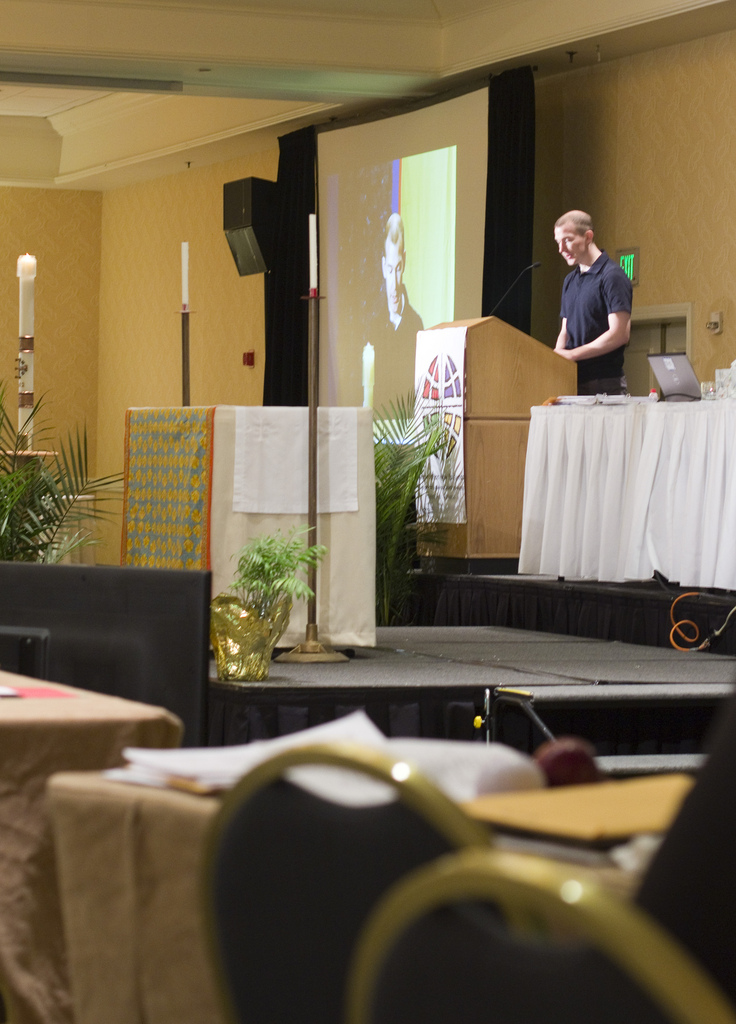
 Preached by the Seminiarianzilla at Trinity LIC.
June 17, 2012
3rd Sunday after Pentecost: Mark 4:26-34; 2 Corinthians 5:6-17; Ezekiel 17:22-24
At the beginning of this chapter of Mark, we have Jesus teaching by the sea. And after teaching to a large crowd, he retreats to where it is only him and his disciples. And the disciples, well, they’re confused – they want to hear more – more lessons and parables – so Jesus gives them a few more – and they all seem to deal with being a farmer.
Now, I didn’t grow up on a farm and the only yard work I would do was a little weeding now and again. But I remember, when I was in elementary school, there was this science experiment that we would do every year. We’d get to a segment where we were learning about ecosystems, or the environment, or why trees didn’t grow at the top of mountains but they do at the bottom – and everyone would be given the same materials – a ziplock bag, a wet brown paper towel that felt like sandpaper, some masking tape, and one big lima bean. We’d all take that big old bean, put it in the zip lock bag, shove in the wet paper towel, seal it, and tape those bags onto whatever window in our classroom would get the most sun. A few days later, we’d come back, find our bags, and look to see what changed. And if we were lucky – if we did everything right, we had enough water on our paper towel (but not too much), and if we sealed it correctly so it didn’t dry out – we’d see sprouts! These little white and green appendages would snake away from the bean. We’d all be so excited – and the teacher would corral us with our bags of a bean, and we’d get a styrofoam cup, ome soil, and pot it. And I remember taking it home, all proud, and telling my mom and dad about the plant, and how I was going to water it, and I’d put it on the windowsill, and make sure it gets lots of sun, so it can grow big. Because I had learned, through that experiment, what it took to get this little seed to sprout. I was a little farmer in the great wilds of suburbia.
There’s something powerful in that image – in that little experiment. We have this group of little kids, all full of life, and full of so much potential – they’re like seeds – and they’re all working to tend to these little seeds themselves – so that these seeds can grow up. It’s an amazing metaphor for childhood. So, I think, when we read today’s parables from Jesus – don’t we kind of go back to that experiment – or any experience we’ve had trying out our green thumbs? When we read about the mustard seed – that is sown in the ground – and it grows into this shrub that is big, and safe, that birds fly into it to make it their home – it’s hard to not be inspired. It’s hard not to see ourselves as those seeds. We know what’s important when it comes to nourishment, tending, weeding, providing the plant with just the right amount of water, the right amount of sun, so that it can grow into the plant it is suppose to be. We know how plants grow. We know how seeds work. And that seed – it is no longer a metaphor for us, but it becomes us. We are that seed.
The church encourages this, I think. The parable of the mustard seed – it’s a parable that appears everywhere. We use that image to inspire us to do great things. It is the story we use for our capital campaigns for new buildings or to repair old ones, or themes for bible studies and vacation bible schools, and for our faith development classes when we try to learn to be more faithful Christians. We’re the mustard seed, we tell ourselves, but even though we are seeds, we are farmers too. We know how seeds become plants – how their stalks are formed, how much water they need, how much sun they need. So we know how much to sacrifice so that we can raise money to fix our roof. And we know what kind of bible studies to run so that people can recognize God’s presence in their lives. And we know the right games to play and songs to sing so that our children can grow in Christ. We are able to do amazing, wonderful, powerful, prayerful, and faithful things with these images. Many of us actually do change because of these things – we become more faithful – we feel as if we are better Christians than we were before. We feel that our branches are longer, our leaves bigger, our shade darker and cooler – we become energized! We feel like we can reach any of our goals. We set visions for who we are, for where we want to go, and we reach them. Sure, it might be hard work, and it might take time, energy, and a re-prioritizing of our lives – but we become that shrub. We feel more holy. We feel more Godly! And it is a powerful thing to see, to feel, and to witness too.
But what happens when that doesn’t happen? If, in our campaign to fix the building, no grant came through – no one attended our bake sales or the rummage sale – and no one donated. Or, if in our bible studies, we went, we read, we studied, we engaged in conversation – and nothing changed. I mean, in many ways, we will always be seeds – always waiting to reach our full potential – never fully complete and whole and everything that we should be – but that thinking is abstract because what about those days when we feel like we’ll only, always, be a seed – and that the growth that we see promised in these parables that Jesus said – that Jesus spoke to his disciples – what about when we don’t feel it? What about when we know we’ve done everything right and it just doesn’t seem to work. Where does Jesus’s words leave us then?
And that’s tough – tough and not something I have a ready answer for. Because I think we all feel that way at one time or another. Even me, the clergy-in-training, feels this way. As I go through the process of being that prayerful, powerful, spiritual leader – that person worthy of wearing this collar, or these vestments, or to have the honor to preach to you – I sometimes wonder if I’ll become that shrub that others can find rest and security in. And on this day when we honor fathers, and as I get ever so close to being one myself – how do I take that new life, nourish it, raise it, and help him reach his full potential? And no matter how many people tell me how great that I will be, how it will work out, I wonder if I’m really ready or maybe if I’m just a mustard seed pretending to be what I’m not. These are questions, and worries, and wonderings. And, it’s not fun – not something that I want – because i want that confidence that Paul writes, in his letter to the Corinthians – that boasting that he shares. I want that – and, I think, we all need that too.
And maybe that’s the problem with seeing ourselves as the seeds in these parables. Maybe weren’t not suppose to see ourselves as the seeds. What would happen if, instead of seeing ourselves as the seeds that are scattered, that the little thing that is so full of potential – what if we took a look at these parables again, and we put ourselves in a different place. What if we identified ourselves with that anyone, that person who throws the seeds, who isn’t a farmer, who doesn’t know what’s going on – and we look again at Mark 4, verse 28, and read that “the earth produces of itself.” Because that anyone – they never did that experiment I did as a little kid – they never learned what it was needed for a seed to grow. That anyone didn’t even know how to plant a seed correctly! Instead, they just threw it and went about their lives. They didn’t take responsibility for its growth – but the ground did. The ground took that seed, nourished it, provided it with what it needed to grow; all of that – that was the ground’s responsibility – not the anyone. For that seed – it is the ground that mattered – that earth that was important. That is what made the seed reach its potential – a potential that, in the end, was fully shared with the anyone who didn’t grow it correctly in the first place!
That, I think, is the ground for Paul’s confidence. That lack of being responsible for the seed – for its growth – that’s Paul confidence and our confidence too. Because what mattered was the earth, creation itself – that which God gave. God provided the environment for the kingdom to grow – and the anyone had little to do with it. Paul’s confidence rests in what God does – and what Jesus is really promising here, I think, is that the kingdom will come, that the kingdom is coming – and the kingdom doesn’t depend on anything that we do. It doesn’t matter how good of a farmer we believe we need to be – or how tightly we seal the ziplock bag in our lives to keep the good things in – no – the kingdom does not depend on us. It only depends on God – and God’s work – and what God did through Christ on the Cross.
It’s through that Cross – that gruesome symbol of death and suffering – the exact opposite of the new life in our parables today – that paradoxical ground defines who we are brothers and sisters in Christ. In Jesus’s death, we all died – we were planted into the earth. And in Jesus’s raising, we are all raised as new creations! It is in our baptisms that we are joined with Christ – in that external act, when water is poured over us when we are young, or old, baby, or adult – that confidence is Paul’s confidence and it’s our confidence – because we are grounded in what God has done, and God continues to do – bringing new life through Grace and Love in this and every place. When it comes to the parable of the mustard seed that becomes the large shrub – I think it is better to see us not as the seed that grew but as the birds that nest. Because it is in the works of God that we find our rest, our security, our shade, and our joy.
Our confidence, then, doesn’t rest in what we do – or how we feel – or what we need to do. That kingdom of God – that thing that God does – our confidence, our trust, our faith – it rests in the promise. That is what sustains us even when we doubt, struggle, and even when we feel like we’ll always only be a seed, trapped in a poorly sealed ziplock bag, and all the moisture has dried up. Because our confidence rests in God’s promise that – regardless of who we are, in baptism we have died with Christ and we have been raised with Christ too. Our confidence is that we have been loved – claimed and gathered by God. And it is there, by being claimed by God, that I think we fully become like birds. We are made free – free to act as if the kingdom of God does not depend on us; free to act as if that shrub does not depend on what we do, or control, or on how good of farmers we can be. We are free instead to do that which can seem so impossible sometimes – we are free to turn outside ourselves – to look to our neighbors, our family, our friends, and complete strangers – and love them, walk with them, help them, honor them – and raise them up as we have been raised. Because it’s that love of Christ – that love that is given to us – that is what urges us on. That love of Christ, to be a voice for the voiceless, to feed the hungry, to fight against all forms of oppression and discrimination – that love – that love is given to us, freely, without charge, and is the ground of who we are as Christians. We are free to love – in fact, we are called to love – to be that light in the world – to help the seeds around us grow and every bird to find safety and shelter. Because that promise of Christ – that the Kingdom of God will come, and that it does not depend on us but that its bounty is for us – that’s what it means to be loved – that’s what it means to be seen by God as being worth being loved – and that’s what we boast and proclaim – because we are free to live as if God has taken charge, no matter how small we think we truly are.
Amen.

 I think part of good parenting is boundaries. I think parents should have their own identity seperate from their kids and vice versa. We all have our own tastes, wants, desires, and thoughts – and I think we should all embrace that. I hope that I’ll be able to support my kid’s taste and I hope that he’ll be able to support mine.