Companion: Looking for what’s Hidden

Now before the festival of the Passover, Jesus knew that his hour had come to depart from this world and go to the Father. Having loved his own who were in the world, he loved them to the end. The devil had already put it into the heart of Judas son of Simon Iscariot to betray him. And during supper Jesus, knowing that the Father had given all things into his hands, and that he had come from God and was going to God, got up from the table, took off his outer robe, and tied a towel around himself. Then he poured water into a basin and began to wash the disciples’ feet and to wipe them with the towel that was tied around him. He came to Simon Peter, who said to him, “Lord, are you going to wash my feet?” Jesus answered, “You do not know now what I am doing, but later you will understand.” Peter said to him, “You will never wash my feet.” Jesus answered, “Unless I wash you, you have no share with me.” Simon Peter said to him, “Lord, not my feet only but also my hands and my head!” Jesus said to him, “One who has bathed does not need to wash, except for the feet, but is entirely clean. And you are clean, though not all of you.” For he knew who was to betray him; for this reason he said, “Not all of you are clean.” After he had washed their feet, had put on his robe, and had returned to the table, he said to them, “Do you know what I have done to you? You call me Teacher and Lord—and you are right, for that is what I am. So if I, your Lord and Teacher, have washed your feet, you also ought to wash one another’s feet. For I have set you an example, that you also should do as I have done to you. Very truly, I tell you, servants are not greater than their master, nor are messengers greater than the one who sent them. If you know these things, you are blessed if you do them.

Jesus said, “Now the Son of Man has been glorified, and God has been glorified in him. If God has been glorified in him, God will also glorify him in himself and will glorify him at once. Little children, I am with you only a little longer. You will look for me; and as I said to the Jews so now I say to you, ‘Where I am going, you cannot come.’ I give you a new commandment, that you love one another. Just as I have loved you, you also should love one another. By this everyone will know that you are my disciples, if you have love for one another.”

John 13:1-17,31b-35

My sermon from Maundy Thursday (April 13, 2017) on John 13:1-17,31b-35. Listen to the recording at the bottom of the page or read my manuscript below:

One of the nice things about having cats again is that, when I’m eating, I’m never really alone. When I pull out a chair and take a seat at the dining room table, I notice the tips of cat ears sitting patiently on the other side. Pretty soon, there’s a cat on the table, hoping that today will be the day when I let him drink all the milk in my cereal bowl. It’s adorable and annoying, especially when they try to grab the spoon right out of my hand. Cats and dogs, are some of the most persistent, patient, and fuzzy dining companions we get to have. And even when we think we’re alone, we’re not. They’re there, lying in wait under an ottoman, or a chair, or the table itself. These hidden companions are part of the story that unfolds when we sit for a meal. And if we forget that they are there, we risk having our lunch swiped from us when we’re not paying attention.

Paying attention to our hidden companions isn’t just something to do at dinner; it’s important for tonight’s reading from John as well. These verses from John 13 are heard every Maundy Thursday. And they make us uncomfortable because Jesus does a really strange thing: he washes feet. And even if we don’t know why foot washing was a thing in the ancient world, there’s something inside us that knows that foot washing is just – weird. In the words of one of our high school youth at our youth group meeting last Sunday, foot washing is… “Gross.” Feet are in shoes all day long. They get dry and cracked. They literally carry us around, and we barely think about them, until they stop working the way we expect. Feet are also beneath us. When we look down, there they are. So when Jesus gets up, removes his clothing, wraps a towel around his waist, and kneels at the feet of his students – he, the Master, the Teacher, the one who was there before the world was, is suddenly beneath them. He’s below. He’s serving the ones who are called to serve him. And when we imagine what footwashing actually was like in ancient Jerusalem – a city without indoor plumbing, or paved streets, or people owning closed-toed shoes – gross doesn’t even come close to describe it. The one usually assigned to wash feet would be a slave or a servant. A teacher shouldn’t be a footwasher. And yet…here is Jesus…being gross.

So if our feet are washed, what does that bring? I mean, it feels nice when our feet are in good shape and look good but Jesus is doing more than giving his disciples pedicures. We need to pay attention to the hidden companions, the hidden verses, that accompany this text. And those verses are…everywhere. They show up in the very first verse, in the word “hour.” That one word pushes us back to the start of Jesus’ ministry in John, when he is at a wedding and the party is about to end prematurely because the wine has run out. Jesus’ mom informs Jesus and he says “my hour has not yet come.” So he makes some wine out of water. It’s a wedding party full of food and drink that starts Jesus’ journey. And it’s tonight, when his hour finally comes, that his ending begins with a dinner party. The foot washing is more than one act of service we’re asked to replicate and ritualize. The foot washing, in the words of Rev. Karoline Lewis in her commentary on John, “is somewhat of a microcosm of God becoming flesh, God dwelling with us, now no greater than we are” (page 181). When Jesus washed his disciples’ feet, he summarized his entire ministry. The foot washing is a capstone to the life that Jesus lived. It completes his narrative, this part of his story, and becomes“a pattern of being….that the disciples will now need to take on” (page 181).

And this pattern of being is hard. There are moments when we’re asked to love those we don’t even like. There are moments when we are asked to serve people we do not understand and people we don’t want to even try to understand. The life of love Jesus embodies upends our expectations of what’s normal. Even if we hear the call to serve all people like Jesus did, there are still some people we don’t want to love. There are some we don’t think deserve to be loved. And that’s why Love is hard; love is difficult; because love messes with our expectations and reveals to us what God really wants us to see.
And there’s another hidden companion to tonight’s text that we need to see. We need to hear what happens to that evil, hidden in the room and explicitly declared in verse 2. Among the disciples, sitting in the room, is Judas. He watches as Jesus washes their feet. He feels the water that Jesus pours over his toes. His feet are dried by his teacher, his friend, and his rabbi. And, in verses we do not hear tonight, after all of that, Judas leaves. He heads out, into the night. Now, Jesus knew Judas will do this. He knew his hour had finally arrived. And yet…Jesus still served. He still washed. He still loved everyone, including the one who will deny him, the one who will betray him, and the ones who will run away when the cross finally comes.

The hidden companion to Jesus’ command to “love one another” is Judas. In the act of footwashing, the disciples are confronted with the entirety of Jesus’ story. For some, that sparked confusion. For others, hope. And for Judas…well…he left. In front of the entire group, he just walked out. The fear and tension and confusion around that dinner table must have been palpable. And it’s in the middle of all of that when Jesus said “love one another.” Love. In the face of betrayal, in the face of fear, in the face of uncertainty and our unrealized expectations, just love. Jesus doesn’t tell his followers to be a hidden companion in a world that doesn’t always know him. He tells them to love like he did, in all the different ways he modeled throughout his ministry and in the many other ways God will inspire them to see. Foot washing was just the capstone to the story of love Jesus lived out. And as he served, so should we, being visible companions to each other, to our neighbors, and to the One God sent to upend the world through love.

Amen.

Play

Red: Blood in Exodus.

Our First Reading is Exodus 12:1-14.

It was my first year in college. I was picking up some lunch while on campus. I don’t remember why the glass Snapple bottle slipped from my fingers but I do know what happened next. I caught the bottle but I was too late. The bottle shattered on the ground while my hand was around it. A deep gash tore through one of my fingers. A trip to the university health center was in order.

At the health center, I was prepped for stitches. The nurse asked me if it would be okay for a student volunteer to watch the procedure. The student was thinking about a medical career. I said, “Sure. The more the merrier.” The physician assistant invited the student (and me) to watch the simple procedure. The finger still bled but I was fascinated. I tried to get the best position possible to see my finger put back together. The pre-med student looked at the still bleeding finger. She then ran out of the room. The sight of all that blood was making her nauseous.

In our reading from Exodus tonight, blood is central to the text. The ancient world did not have the medical knowledge we do. How the body functioned was a mystery to them (and is still a mystery today). But the ancient world did know the importance of blood. Blood flows. Blood is pumped through the body. Blood makes life happen.

And life is what the blood on the door is all about. Each family gathered together to take the life of a lamb (its blood) and make a sign on their door. The angel, checking each household, would see the sign of life and passover their house. The life of the lamb does more than keep the family safe. The life of the lamb also invites the family to experience the entire Exodus story. A story where God’s people are moved from slavery into freedom; from suffering into abundant life. God doesn’t want God’s people to just survive. God wants God’s people to thrive.

The story of Maundy Thursday is what a thriving life looks like. A life that thrives is a life that gives. A life that thrives is a life that serves even those who betray it. A life that thrives is a life that sees Jesus, serves everyone, and always loves.

Each week, I write a reflection on one of our scripture readings for the week. This is from Christ Lutheran Church’s Worship Bulletin for Maundy Thursday, 4/13/2017.

Collision: Two Parades Enter Jerusalem

Our First Reading is Matthew 21:1-11.

Broken branches. Dirty cloaks. A road covered with whatever is at hand. Today is Palm & Passion Sunday. We are beginning our journey through the center of the church year. We will spend this week re-experiencing Jesus’ final journey into Jerusalem. Jerusalem is flooded with visitors and tourists. The festival of Passover is about to begin. We can imagine every home, hotel, motel, and campground is bursting at the seams with guests. People can barely move through marketplaces jammed with merchants selling souvenirs, knick-knacks, food and more. Jerusalem is full.

And then Jesus comes. A crowd celebrated his arrival by putting cloaks and branches on the ground. By covering the road, dust and dirt stay on the roadway. Jesus’ donkey stays clean. The crowd treats Jesus like a king returning home from a victorious military campaign. He should have gold banners, soldiers carrying swords and shields, and prisoners of war and booty to show off. The entire city should be in their Sunday best to welcome him home. But, instead, we have a crowd full of tourists, the poor, and the sick. The crowd gathered at the last minute so they cut down palm branches from trees in the city. The crowd of almost inconsequential people meets a king who comes with “an army” of only a handful of disciples.

According to Matthew, the crowd that welcomes Jesus was large. But there’s a larger crowd that did not know who Jesus was. It’s probable that, at the same time Jesus is entering the city, another procession is entering Jerusalem from the other side. With so many people in the city, the Roman Empire needed to make an appearance. The Roman Governor Pontius Pilate arrived in the city at the head of his legion. His soldiers would keep an eye on the crowds during Passover and serve as a reminder that Rome is in charge. Rome’s procession would have banners with gold eagles on top. Every soldier would have their swords and spears ready to use. Pilate’s procession would inspire awe and fear, reminding Jerusalem that the mightiest empire in the world is in control.

Jesus and Rome are on a collision course. The might of the world is about to meet the might of God. Even 2000 years after Jesus’ death and resurrection, we still place our trust in our ability to force others to do our will. We still celebrate power. Our power is about to encounter God. And, for a moment, we’re going to think we’ve won.

Each week, I write a reflection on one of our scripture readings for the week. This is from Christ Lutheran Church’s Worship Bulletin for Palm Sunday, 4/9/2017.

A Wide Saddle: Jesus has a sidecar in Jerusalem

When they had come near Jerusalem and had reached Bethphage, at the Mount of Olives, Jesus sent two disciples, saying to them, “Go into the village ahead of you, and immediately you will find a donkey tied, and a colt with her; untie them and bring them to me. If anyone says anything to you, just say this, ‘The Lord needs them.’ And he will send them immediately.” This took place to fulfill what had been spoken through the prophet, saying, “Tell the daughter of Zion, Look, your king is coming to you, humble, and mounted on a donkey, and on a colt, the foal of a donkey.” The disciples went and did as Jesus had directed them; they brought the donkey and the colt, and put their cloaks on them, and he sat on them. A very large crowd spread their cloaks on the road, and others cut branches from the trees and spread them on the road. The crowds that went ahead of him and that followed were shouting, “Hosanna to the Son of David! Blessed is the one who comes in the name of the Lord! Hosanna in the highest heaven!” When he entered Jerusalem, the whole city was in turmoil, asking, “Who is this?” The crowds were saying, “This is the prophet Jesus from Nazareth in Galilee.”

Matthew 21:1-11

My sermon from Palm Sunday (April 9, 2017) on Matthew 21:1-11.

Play

4 days later: a sermon on messaging Jesus.

Now a certain man was ill, Lazarus of Bethany, the village of Mary and her sister Martha. Mary was the one who anointed the Lord with perfume and wiped his feet with her hair; her brother Lazarus was ill. So the sisters sent a message to Jesus, “Lord, he whom you love is ill.” But when Jesus heard it, he said, “This illness does not lead to death; rather it is for God’s glory, so that the Son of God may be glorified through it.” Accordingly, though Jesus loved Martha and her sister and Lazarus, after having heard that Lazarus was ill, he stayed two days longer in the place where he was. Then after this he said to the disciples, “Let us go to Judea again.” The disciples said to him, “Rabbi, the Jews were just now trying to stone you, and are you going there again?” Jesus answered, “Are there not twelve hours of daylight? Those who walk during the day do not stumble, because they see the light of this world. But those who walk at night stumble, because the light is not in them.” After saying this, he told them, “Our friend Lazarus has fallen asleep, but I am going there to awaken him.” The disciples said to him, “Lord, if he has fallen asleep, he will be all right.” Jesus, however, had been speaking about his death, but they thought that he was referring merely to sleep. Then Jesus told them plainly, “Lazarus is dead. For your sake I am glad I was not there, so that you may believe. But let us go to him.” Thomas, who was called the Twin, said to his fellow disciples, “Let us also go, that we may die with him.”

When Jesus arrived, he found that Lazarus had already been in the tomb four days. Now Bethany was near Jerusalem, some two miles away, and many of the Jews had come to Martha and Mary to console them about their brother. When Martha heard that Jesus was coming, she went and met him, while Mary stayed at home. Martha said to Jesus, “Lord, if you had been here, my brother would not have died. But even now I know that God will give you whatever you ask of him.” Jesus said to her, “Your brother will rise again.” Martha said to him, “I know that he will rise again in the resurrection on the last day.” Jesus said to her, “I am the resurrection and the life. Those who believe in me, even though they die, will live, and everyone who lives and believes in me will never die. Do you believe this?” She said to him, “Yes, Lord, I believe that you are the Messiah, the Son of God, the one coming into the world.” When she had said this, she went back and called her sister Mary, and told her privately, “The Teacher is here and is calling for you.” And when she heard it, she got up quickly and went to him. Now Jesus had not yet come to the village, but was still at the place where Martha had met him. The Jews who were with her in the house, consoling her, saw Mary get up quickly and go out. They followed her because they thought that she was going to the tomb to weep there. When Mary came where Jesus was and saw him, she knelt at his feet and said to him, “Lord, if you had been here, my brother would not have died.”

When Jesus saw her weeping, and the Jews who came with her also weeping, he was greatly disturbed in spirit and deeply moved. He said, “Where have you laid him?” They said to him, “Lord, come and see.” Jesus began to weep. So the Jews said, “See how he loved him!” But some of them said, “Could not he who opened the eyes of the blind man have kept this man from dying?” Then Jesus, again greatly disturbed, came to the tomb. It was a cave, and a stone was lying against it. Jesus said, “Take away the stone.” Martha, the sister of the dead man, said to him, “Lord, already there is a stench because he has been dead four days.” Jesus said to her, “Did I not tell you that if you believed, you would see the glory of God?” So they took away the stone. And Jesus looked upward and said, “Father, I thank you for having heard me. I knew that you always hear me, but I have said this for the sake of the crowd standing here, so that they may believe that you sent me.” When he had said this, he cried with a loud voice, “Lazarus, come out!” The dead man came out, his hands and feet bound with strips of cloth, and his face wrapped in a cloth. Jesus said to them, “Unbind him, and let him go.”

Many of the Jews therefore, who had come with Mary and had seen what Jesus did, believed in him.

John 11:1-45

My sermon from the Fifth Sunday in Lent (April 2, 2017) on John 11:1-45.

******

That message Mary and Martha sent to Jesus – what did it look like? I mean, we know what the message said but I want to know what the medium of the message was. In Jesus’ day, there were no post offices, stamps, or mail carriers. They didn’t have phones to call or a Facebook profile to post a message to, either. Sending a message to someone far away was a very hard thing to do. And since communication was so slow, people were never quite sure where another person might actually be. If they were like Jesus, and traveled from town to town following an itinerary that looked almost random, getting a message to him would be more involved than just sending a quick text to his phone. At the start of today’s story from the gospel according to John, Jesus is across the Jordan, hanging out in the place where John the Baptist taught and preached. He’s on the other side of the border because the religious and political leaders of Judea are turning against him. Jesus spends time there, preaching and teaching, in a place that’s wild and untamed. Mary and Martha might have know Jesus was across the river but I don’t think they knew exactly where. Their grief-filled message would need to track Jesus down. And there were a few ways they could do this. Mary and Martha could have sent their servant or slave to find Jesus. Another option was to pay a traveling merchant to hand the message to Jesus. Either way, Mary and Martha were doing all they could to tell Jesus that their brother was dying. In the middle of their grief, they spent time, effort, and money to deliver their words of anguish and fear to the one person they knew who could make a difference. 

A few years ago, I was sitting in my church office when I noticed a request on Facebook. Someone I didn’t know was trying to send me a private message. Now, this wasn’t abnormal. As somehow who grew up with the internet, I’m used to getting random messages. And most of these messages are spam – they’re fake. It’s easy and cheap to send a lot of words to all kinds of people. But this looked different. So I opened it. And as my eyes quickly scanned the note, I realized the message wasn’t fake. A young woman was trying to get ahold of some next of kin. She knew my older brother Gus, and he had listed me as a family on his Facebook profile. That list on Facebook was the only contact information for his family that she had. She had a message to share and she was reaching out to me in the only way she could. And that’s how I found out that my older brother had died: via a few sentences through a message on Facebook. 

Now, there’s an old saying that the medium is the message. On one level, that means that the medium sharing the message – say tv, or a newspaper, or the media, or snapchat or facebook or some other online thing – the medium the message passes through is inherently part of the message itself. In Jesus’ day, the words Mary and Martha sent to him were almost secondary to the fact that they sent him a message in the first place. In the first century, sending a message required time, effort, and money. When Jesus first heard from Mary and Martha’s servant or from a merchant that they had a message for him, he knew how serious the words would be. In an era when communication over long distances was really, really, hard – every message Jesus received, mattered. Each word given to him took time, energy, and money to create. Words in Jesus’ day were not cheap or easy. The message Mary and Martha send to Jesus wasn’t only about Lazarus’ illness. The message also told him just how concerned and afraid his sisters were and how close to death Lazarus actually was. 

 But we also know words can bring life. And I wonder if that is why this gospel calls Jesus: the Word. Now, I know the gospel according to John calls Jesus the Word in a very specific way. The Word is the english translation of the greek word Logos which is a philosophical term that means more than just words on a page. I still struggle to fully unpack what Logos actually means but there’s something about Jesus and the words he uses that is very life-giving. If the medium is the message, than the words Jesus shares are more than just talking points, teaching moments, or thoughts about God. Jesus’ words carry with them the entirety of his story. The message he brings is held together by the story of God living a human life, experiencing human joys and pain, and a God who sheds tears at the grave of his friend. The medium of Jesus is not only that he’s God’s Son. The medium of Jesus is that he’s also a full human being, full of all kinds of human experiences. His words are not words only for someplace else. His words are for the here and now. His words are for real human beings living real, messy, and sometimes unpredictable  lives. By being caught up in Jesus’ message, we are also caught up in Jesus himself. We are wrapped up and surrounded by a God who makes a promise that our relationship with the divine is not something that only materializes once we die. Our relationship with God, our eternal life, begins in the here and now. To be caught up by the Word is to be caught up in a God who knows what it’s like to cry and to die and to live through it all.  

The medium of Facebook is a very weird medium to hear that a brother has died. With the amount of words, images, and videos we scroll past everyday, words can feel very cheap today. It only takes a moment to connect with someone on the other side of the world and share with them words, emjois, and a picture of cats. Yet, through Jesus, our words are never cheap. Through the gift of faith that we all share, we are a medium that is bigger than just ourselves. In the meal, song, and prayers we share, we are connected by a word of promise to the eternal Word itself. We are wrapped up in a new life, in a resurrection, that’s already begun. Lazarus’ life with God didn’t begin only after he came out of the tomb. His new reality didn’t start only when the burial cloths were removed from his hands. His real life began years before, when Jesus first found him. And that life continues, no matter what, because even an expensive word of fear or a cheap word of death shared through Facebook can’t overcome the Word of life, the word of promise, and the word of eternal love that God gives to each of us.

Amen.

Play

Rattling Bones

Ezekiel is having a moment today. In our first reading (Ezekiel 37:1-14), “the hand of the Lord” sets him down in the middle of a valley. Ezekiel is having a vision which might be happening only in his mind. For him, this could be a very vivid dream. But I like to make this story real. I see God physically grabbing Ezekiel by the hair and carrying him into this valley full of dried bones. When he lands, I imagine his feet touching the bones. The bones rustle, clang, and clatter as he kicks them around. His religious concern about being unclean is overwhelmed by the sheer number of bones he sees. The visual overload he is experiencing would stop him from even processing what is going on. In that moment, he wouldn’t know what to say. His brain would just shut down. He could do nothing but look and see. And, in the process, he would be as still and dry as the bones around him.

God commands Ezekiel to prophesy to the bones. Prophesy is more than a prediction of the future. Prophecy is a life-giving word for right now. The words Ezekiel shares are words of promise. As he speaks, life takes hold, even among old bones. The bones start to move. The bones start to rattle. And if I was there with Ezekiel, I would be terrified. It’s sometimes easier to stay among dry bones than to see those bones rattled. It’s sometimes easier to stay with the status quo or keep things the way they are than to see the chaos and unpredictability that rattling can bring about. As the bones rattle, fear grows. But the rattling of bones is not the end of the story. Change happens. The bones turn into something new. As the vision evolves, God’s own breath comes into view.

When Ezekiel experienced this vision, he was living through the destruction of Jerusalem. Waves and waves of people were being deported from the city. The Babylonians would burn God’s Temple to the ground. The dry bones Ezekiel sees are not only metaphorical. They point to a community feeling hopeless because their sense of who they are is coming undone. Their world felt like it was coming to an end. But God promises God’s presence even when conflict, loss, and fear are all we feel. God’s Word makes a difference. And the final chapter of the story God is writing is a story that includes hope, life, love, and us.

Each week, I write a reflection on one of our scripture readings for the week. This is from Christ Lutheran Church’s Worship Bulletin for 5th Sunday in Lent, 4/2/2017.

I Met a Sitting US Senator

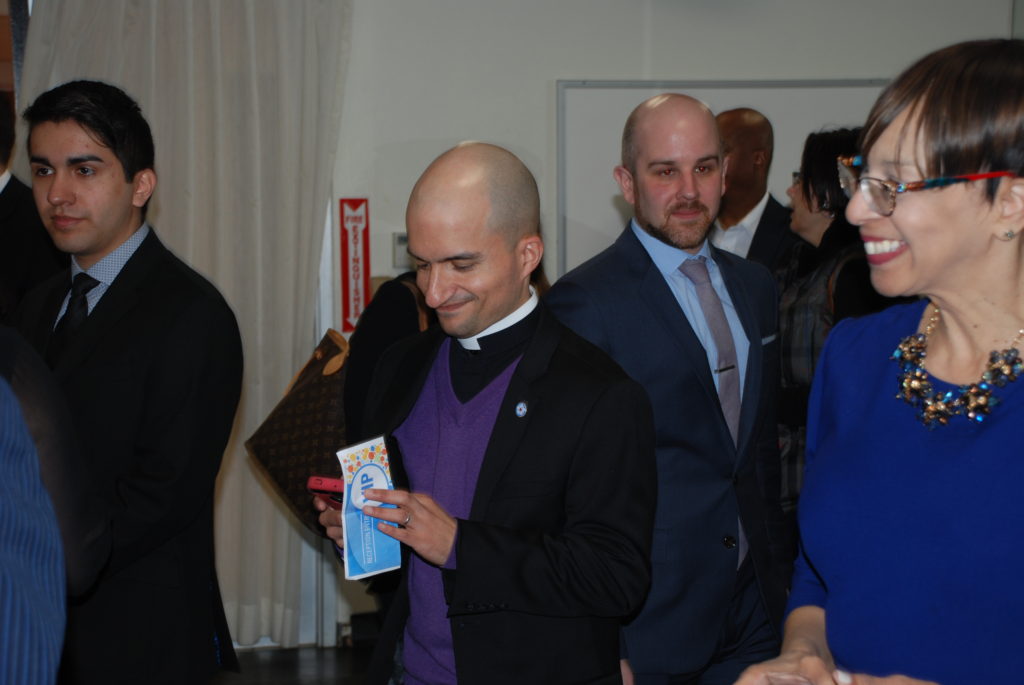
The Adult Choir and Music Director at my church is the NJ State Teacher of the Year. On Sunday she was recognized by Senator Bob Menendez at an event in honor of Evangelina Menendez (the Senator’s mother) and Women’s History Month. I was invited to the VIP reception before the ceremony. It was my first time talking to a sitting US Senator face-to-face.

They also caught me in my natural pose.

Photos provided by the office of Senator Bob Menendez.

Period. A sermon on interpretation and who Jesus sees.

As [Jesus] walked along, he saw a man blind from birth. His disciples asked him, “Rabbi, who sinned, this man or his parents, that he was born blind?” Jesus answered, “Neither this man nor his parents sinned; he was born blind so that God’s works might be revealed in him. We must work the works of him who sent me while it is day; night is coming when no one can work. As long as I am in the world, I am the light of the world.” When he had said this, he spat on the ground and made mud with the saliva and spread the mud on the man’s eyes, saying to him, “Go, wash in the pool of Siloam” (which means Sent). Then he went and washed and came back able to see.

The neighbors and those who had seen him before as a beggar began to ask, “Is this not the man who used to sit and beg?” Some were saying, “It is he.” Others were saying, “No, but it is someone like him.” He kept saying, “I am the man.” But they kept asking him, “Then how were your eyes opened?” He answered, “The man called Jesus made mud, spread it on my eyes, and said to me, ‘Go to Siloam and wash.’ Then I went and washed and received my sight.” They said to him, “Where is he?” He said, “I do not know.”

They brought to the Pharisees the man who had formerly been blind. Now it was a sabbath day when Jesus made the mud and opened his eyes. Then the Pharisees also began to ask him how he had received his sight. He said to them, “He put mud on my eyes. Then I washed, and now I see.” Some of the Pharisees said, “This man is not from God, for he does not observe the sabbath.” But others said, “How can a man who is a sinner perform such signs?” And they were divided. So they said again to the blind man, “What do you say about him? It was your eyes he opened.” He said, “He is a prophet.” The Jews did not believe that he had been blind and had received his sight until they called the parents of the man who had received his sight and asked them, “Is this your son, who you say was born blind? How then does he now see?” His parents answered, “We know that this is our son, and that he was born blind; but we do not know how it is that now he sees, nor do we know who opened his eyes. Ask him; he is of age. He will speak for himself.” His parents said this because they were afraid of the Jews; for the Jews had already agreed that anyone who confessed Jesus to be the Messiah would be put out of the synagogue. Therefore his parents said, “He is of age; ask him.” So for the second time they called the man who had been blind, and they said to him, “Give glory to God! We know that this man is a sinner.” He answered, “I do not know whether he is a sinner. One thing I do know, that though I was blind, now I see.” They said to him, “What did he do to you? How did he open your eyes?” He answered them, “I have told you already, and you would not listen. Why do you want to hear it again? Do you also want to become his disciples?” Then they reviled him, saying, “You are his disciple, but we are disciples of Moses. We know that God has spoken to Moses, but as for this man, we do not know where he comes from.” The man answered, “Here is an astonishing thing! You do not know where he comes from, and yet he opened my eyes. We know that God does not listen to sinners, but he does listen to one who worships him and obeys his will. Never since the world began has it been heard that anyone opened the eyes of a person born blind. If this man were not from God, he could do nothing.” They answered him, “You were born entirely in sins, and are you trying to teach us?” And they drove him out.

Jesus heard that they had driven him out, and when he found him, he said, “Do you believe in the Son of Man?” He answered, “And who is he, sir? Tell me, so that I may believe in him.” Jesus said to him, “You have seen him, and the one speaking with you is he.” He said, “Lord, I believe.” And he worshiped him.

Jesus said, “I came into this world for judgment so that those who do not see may see, and those who do see may become blind.” Some of the Pharisees near him heard this and said to him, “Surely we are not blind, are we?” Jesus said to them, “If you were blind, you would not have sin. But now that you say, ‘We see,’ your sin remains.

John 9:1-41

My sermon from the Fourth Sunday in Lent (March 26, 2017) on John 9:1-41.

Play