There’s a joke in my clergy circle that people think all we do is sit around and pray all day. Of course, we don’t. We’re busy. We do things. We plan, write sermons, go to committee meetings, do, uh, things – we’re busy people. Oh. And we do pray…. occasionally.
Yesterday, I was doing what I usually do – being busy – when a gentleman walked into the church. He sat in the pews for a bit and then walked back to the office. I was in the middle of printing out the three Sunday school lessons I just finished – the pages jumped completely out of the printer and were all over the floor – when he came into the office. I looked up, he asked for someone to talk to, I said he could talk to me, I left the paper on the floor, we stepped out, and we chatted. And chatted. And chatted. Over two hours later, we parted ways. I never learned his last name – but I listed to his story. He cried several times. I tried to help. And I did what I’ve already learned to do – don’t worry about whether the story is true – just go with it and see what happens. That’s the cost of being an urban church that keeps its doors open – all sorts of people can walk in. And I listen to them, pray with them, and hope that God helping me say the right words. Because, well, that’s part of my job now.
Later in the afternoon, during confirmation class, we started the Lord’s Prayer. And as we talked about prayer in general, I brought up the story of how a random person I didn’t know, came into church, and asked me to talk with him. He told me his heart wrenching story – and we prayed. That wasn’t even the punch line – but I was interrupted by my students.
“Wait – what?” asked one of the students.
“Really?” asked another.
“So…wait…do you have another job?”
I didn’t know how to take that question. Did they not know I work as an intern full time? “Nope – all of this is my job now.”
“And that’s what all the pastors here do?”
“Yep. Pretty much.”
“Wow” said another.
“That’s so cool.”
You see, I know that those of us in the church world don’t spend all our days praying, but there’s at least a dozen twelve year olds and thirteen year olds in New York City who don’t seem to think that having that part of your job description is such a bad thing.
Yesterday, while skimming through the daily Politico Playbook, I saw the following blurb.
INAUGURAMA – Obama to be sworn in on MLK and Lincoln Bibles: The Presidential Inaugural Committee will announce today that on Mon., Jan. 21 — the 150th anniversary of the Emancipation Proclamation, and 50 years after the birth of the Civil Rights movement — President Obama will be sworn in using a Bible that belonged to Dr. Martin Luther King Jr. and the Lincoln Bible, which Obama used in 2009. At his official swearing-in on Sunday, the President will use the Robinson Family Bible, which belonged to the First Lady’s grandmother. On both days, Vice President Biden will use the Biden Family Bible, which he used each time he was sworn in as a U.S. Senator, and in 2009.
After reading that, I immediately sent an instant message to my wife lamenting our lack of a family bible.
Now, our apartment is full of bibles. My wife has several personal bibles, including her youth group bible with its own classy jacket/sleeve/handle/lunchbox/whatever-you-call-those-things. And, since I’ve been in seminary, my bible habit has become unhealthy. Several copies of the NRSV, study bibles, a note taking NRSV with my name engraved on the cover that was a wedding gift from my wife, and several other translations (KJV, RSV, Inclusive, Shocken, etc) and Original Languages (Greek, Hebrew) are all over the place. And there’s also bible software on my computer with several translations as well. In regards to just the sheer amount of biblical material in my apartment, we are a biblical household. We’re drowning in the stuff. And I could always use more. You can never NOT have enough bibles, in my opinion.
But we don’t have a family bible. I don’t think my folks do – though my mom might have a bible from her family floating around. But there’s nothing in my apartment that, if Oliver ever became president, he could bust it out and get sworn in on it. It’s possible my extended family has something that would work – but, alas, there isn’t one sitting in my house. And since Oliver only has 25 (or is it 27?) years before he’s eligible to run for the House of Representatives, I feel that this problem must be urgently fixed. He’s already seen enough episodes of The West Wing from Netflix (so glad it is on Netflix now), that I’m sure he’s caught the political bug. Or maybe he’s just into bugs (a song was sung about bugs on the most recent episode of Yo Gabba Gabba that he watched). Either way, I’m not taking any chances. This is important stuff that needs to be figured out RIGHT NOW.
But what should we look for in a family bible? What characteristics should it have? And how many coffee stains can I accidentally pour on it to make it authentic?
So, today, I was told that I didn’t speak like I’m from around here.
Today was our monthly conference meeting. The pastors and interns throughout Manhattan woke up early, grabbed a cup of coffee, and traveled to my church. I arrived before them, helped setup, and learned what parts of the opening worship service I was going to lead. Two days prior, I suggested to my supervisor that we should run through Morning Prayer as listed in the ELW. She listened to me even though she wasn’t familiar with it. It went off without a hitch and I got to re-read the readings for the Magi for the millionth time this week. Which isn’t a problem, really, because I actually dig it the more I read it.
After worship, the pastors and interns gathered there things, headed into the basement, and raided the Starbucks coffee/pastries like they were breaking a forty day fast. Our topics for our discussion today was immigration. One of our presenters, prior to worship, needed a projector and screen. Once again, I was drafted to set that bad boy up (which I did). And it was during the setup where the presenter inquired about where I came from. They thought I didn’t sound like I was “born here.” I thought I just sounded stuffed up from the cold – or maybe hyper energetic because of the grande coffee I downed five minutes before. Either way, I shared my story about being ethnically vague to some folks. He thought I was East Indian. I told him I was born in L.A. That seemed to clear it up.
This incident just reminded me of what I wrote before – about what pastors are given. In many ways, once I receive my first call, I’m going to be whatever people decide I am. They’re going to see my face on the website and Facebook page, see my three names (and, yes, I’m going to be one of THOSE pastors who uses three names) on the board in front of the church, and I’m going to end up just being a lot of things. Father, Priest, Pastor, are the easy ones. Immigrant/Middle Class/Hispanic/Brown/Good-enough/like me/can-understand-me are going to be other ones that I’m not sure I’ll be able to pull off. But, either way, I’m going to be a slate that will be projected on. That doesn’t surprise me – and I always hoped to be seen as immigrant friendly – but I’m always impressed when someone things I’m something that I’m not. East Indian is a new one for me. Sephardic Jew is probably my favorite. And I probably should work on my articulation when I’m tired and coming in from the cold, just to make sure I don’t create a new accent all on my own.
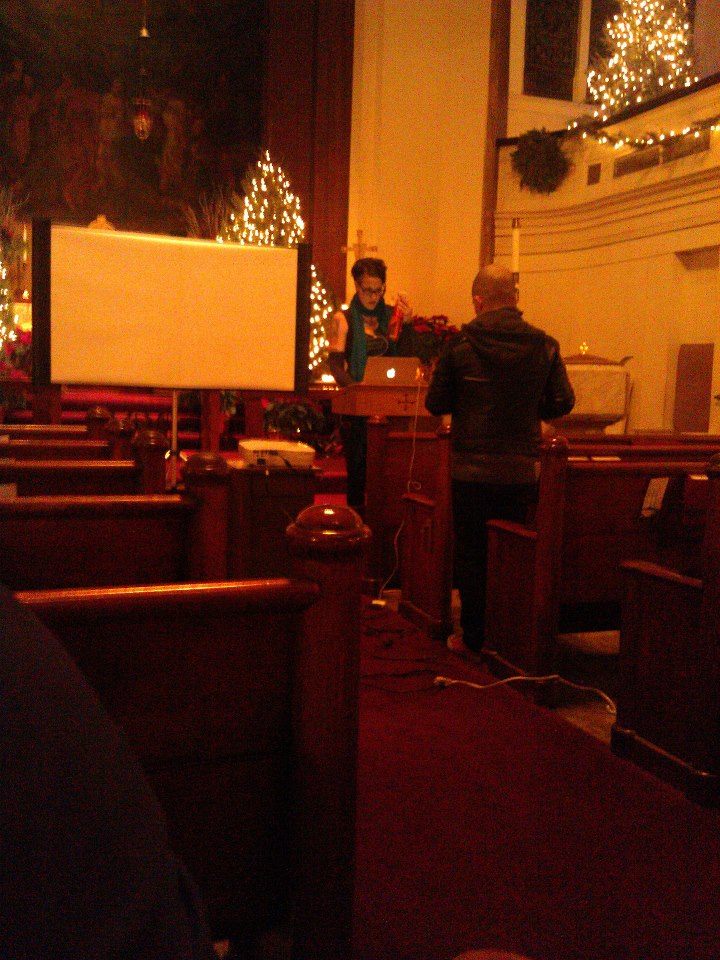
Picture by Danae Hudson. Rev. Nadia Bolz-Weber sets up. And do I really look like that from the back? It was a little before 11 am on Thursday when my supervisor called our church administrator and, like the way of all flesh, I was drafted for a task that my life experiences, in theory, have provided me with the right tools. That evening, I would take the church’s projector and be the techy for that evening’s speech by Rev. Nadia Bolz-Weber, THE Sarcastic Lutheran, and head pastor/founder of House for All Sinners and Saints in Denver, Colorado. I was excited. I’ve been hearing about her ever since I started my seminary track and I wanted to see her in the flesh.
So, I did. And I enjoyed it.
The talk was part of a Project Connect retreat called “Listen! God is calling!” A handful of young adults thinking about church leadership were in attendance. Even though it wasn’t well advertised by our synod, the audience included that handful, and roughly fifty seminary students, pastors, high school students, and me. And, like all good church congregations, I sat by myself in the second row. But that was a-ok with me. I wanted to not be distracted by the hair of anyone in front of me.
I was hoping that Rev. Nadia would tell her story – and she did. She did a great job with “I” statements – this was her story, not “our” story. It was a story of her journey, her church, her experience of the law and gospel. I swore I heard a little Dr. Wengert in her when she kept saying that she’s willing to be thrown infront of the bus of law – and just how awesome Lutheran theology, and God’s grace, is. I’m glad she mentioned that because I’m with her on that one. We, as a church, need to do a better job at tooting our own horn. The Lutheran perspective is awesome. More than awesome, really. And it should be shouted from the freakin’ rooftops.
But scattered throughout her talk, panel response, and Q&A, were tidbits of data and theories that I wrote down. The fact that her church is only 4.5 years is important to note – and that they’re hoping to be self-funding in 18 months. The idea of shared leadership in the liturgy, democratizing the space, and a pro-participation model towards liturgy has helped her church. Her church is a place that can hold pain and, yet, express and experience carnival within the gathering. And her church is rooted in a model of authority where authority is shared and given. I don’t think this would work in all churches but it was neat to see how it worked in her community. I also thought it was neat that she shared her experience that, as a church planter, how she goes, the church goes. If she’s anxious, the church is anxious. If she’s great, the church is great. And it tied into something she’s been talking with her intern about – the notion of holding “space” for the congregation.
This is something I experienced when I presided for the first time. And, really, it is different than preaching, surprisingly. By being the focal point of the congregation, I, in many ways, found myself holding their space. I held whatever they brought to church that day: their certainties, their love, joys, pains, sufferings, doubts – and even their distractions as they checked their email on their iPhones in the middle of the sermon. And I’m sure since I actually believe that the ritual I’m participating in is worth something, that the breaking of bread, the singing of songs, the hearing of scripture, and the fellowship with one another – we are not only being the church but we are having faith, and gospel, done at us – I felt a spiritual, physical, and emotional weight just holding all that energy in that place. And I think it’s different being an intern and holding that space and being a called pastor. A called pastor is put into that place by the congregation. The congregation is giving that pastor that authority and responsibility to hold that space. For an intern, like me, I’m not called by the congregation to be in that space. I’m given the opportunity to learn and experiment with what it means to hold that space. As much as I enjoyed it, I was a partial interloper to that experience. It was a temporary jump into that space – a jump with a time limit. It’s possible, and I have no evidence to back this up, that ordination by the church – an external call and the giving of the stole – actually helps shore up the individual to hold that space that they are called to hold. Without that external call, that external promise through the church, and without the help of God, this holding of space…well..the weight of it all, week after week, would just plain be unbearable.
I’m glad I saw her and I’m glad she’s part of the church. I’m glad for all the work she’s done. And I’m glad that not only does she turn off certain aspects of the church (she’s punk rock, what what), I’m glad that she, at least, proclaims a story that is big enough to not be limited to who she is. In the ELCA, she has a lot of hype. Her church is big news. Her church is sexy. She, herself, is exotic, in the not-your-typical-Lutheran, way. But her story isn’t the only story – even if our current church promotion seems to act like her story, and other churches like hers, are the wave of the future/the only way the ELCA will survive/death to all who are not similar, etc etc. I hope everyone in the audience took to heart her story as an example of how our stories can actually breathe life into the capital C Church. Because if we’re unwilling to share our stories, why should we expect anyone to actually listen to the Story?
So, Oliver’s daycare is closed today but both K and I needed to work. Luckily, through K’s job, Oliver is registered with a backup daycare service. That perk allows Oliver to be inserted into other programs and centers if needed. There wasn’t any space out there in tv-land so, instead, a nanny was sent to our apartment. So, right now, there is a nanny hanging out in my apartment with Oliver. She arrived on time, I gave her the tour, showed her where the diapers were, the formula, etc. Twinkie and Chula both were on their best behavior. The nanny helped Oliver feed and I was out the door.
I have to keep telling myself that this is going to be fine – but, my gut, it is a turning. There’s a lot of stuff going on – and this is just another one of those events that is making me nervous. I realize that this is the first time we’ve had a “babysitter” for Oliver since my parents watched him months ago. So I guess this is what all new parents feel the first time their kid is under the watchful eyes of someone else at home. It’s gonna be fine, it’s gonna be fine, it’s gonna be fine.
But I’m still a nervous wreck. Is this a normal dad response or am I just being weird?
So, 2012 was a low book year for me. According to my records, I took on 38 books this past year. While reviewing my book list, I realized I didn’t read a lot that I actually enjoyed. I mean, I read books. I took what I could out of them. But there’s a lot that didn’t blow me out of the water. It was a pretty low book year for me.
Anyways, here are my top reads from the past year.
Delievered at Advent Lutheran Church. Lessons and Carols. Isaiah 9:2-7; Luke 1:26-33,38; Luke 2:1-14; Luke 21-36; Matthew 2:1-11; John 1:1-14
+++
So ‚Äì here we are ‚Äì in an intermission of sorts ‚Äì halfway through our lessons and our carols. Each time we’ve encountered the words of God’s story ‚Äì words that were read and lovingly spoken out loud – and we responded in song. We started with Isaiah, and we sang; we then heard Gabriel’s greeting with Mary, and we sang; we heard of the census and Jesus’s birth; and we sang. And now we just heard of Jesus’s circumcision, his naming, and presentation, of Simeon and Anna, and the Temple ‚Äì and then there’s me ‚Äì before the song; before we all gather together, join our voices , and sing ‚Äì there’s this ‚Ķ this intermission ‚Äì but unlike a Broadway show ‚Äì the curtain is still up ‚Äì and….and there you all are ‚Äì staring at me ‚Äì in this moment before the song.
It’s a strange space, really, to be right here, right now ‚Äì and ‚Äì it’s a little intimidating. I wonder if it’s like how Mary felt ‚Äì right when the angel appeared ‚Äì before Gabriel spoke; before she heard the words of promise; before she sung her own song ‚Äì a song we heard during Advent. Or when Zechariah heard of the promise that was coming in John ‚Äì right before he disagreed with the words of the angel ‚Äì in that moment before the action; before something happened; before the words come. Or maybe this is kinda like how Jesus looks back on his life because ‚Äì the Christmas story, the story of Jesus’ youth ‚Äì it’s a story where Jesus doesn’t actually do anything. Sure, Luke has that story about Jesus running away to the Temple when he’s twelve ‚Äì but, other than that – we hear a lot about what happens either because of Jesus or what happens to Jesus. He’s born ‚Äì swaddled ‚Äì circumcised ‚Äì named ‚Äì carried ‚Äì put into the arms of people that he doesn’t know ‚Äì he’s blessed, prayed over, but there’s nothing about his cooing, crying, laughter ‚Äì or any of the baby things he did. Before his ministry ‚Äì his early life, to us, is a mystery ‚Äì a moment before his voice, before his action, before his obedience ‚Äì before the Cross ‚Äì before his song.
I grew up in Colorado ‚Äì and my high school, Arapahoe High School ‚Äì Go Warriors! – had a relationship with the Arapho tribe in Wyoming. Each year, the son of the chief would come down from Wyoming and give a scholarship to a member of the graduating class. So this son would stand up on the podium in our football stadium ‚Äì with his back to all our parents and guests, facing 500 suburban kids in rented gowns and hats ‚Äì and he just waited. Everyone’s eyes were fixated on him and he waited. And waited. In the space between his introduction and his speech ‚Äì in that moment before his song ‚Äì there’s this….energy ‚Äì the kind of energy that only silence can bring ‚Äì an energy that fills the air. Even nervous laughter, or the wisecracks from my friend, or a distant car honk couldn’t interrupt it. Nothing could cause that space to end ‚Äì nothing but his words ‚Äì his spoken words. And we all sat there ‚Äì and waited with him ‚Äì until he spoke.
I learned later that what finally caused him to close that open space was an eagle. Next to the football field, behind our backs, was a small creek with elms, oaks, and Aspens. And as he looked out over us ‚Äì after a few minutes ‚Äì he saw this eagle fly out ‚Äì and then he knew that it was time to speak. It’s funny, because I don’t actually remember anything that he said. But I do remember that pause.
The Christmas story ‚Äì as we see it expressed in our lessons today ‚Äì in the voice of Luke, the magi of Matthew, and the opening lines of John ‚Äì all were written decades after Jesus’s death and resurrection. Scholars will argue until the end of the time, how these authors put these writings together ‚Äì what their sources were, how accurate they were, the communities they wrote in, what their motivation were ‚Äì what was it that filled the space before their songs. And we, gathered here, will spend our time reading these stories ‚Äì God’s stories ‚Äì and spend our time with these stories in our own pauses ‚Äì in our own spaces before our completed songs. Because that’s the amazing thing about Christmas ‚Äì and why Christmas isn’t just one day long ‚Äì because God chose to be born ‚Äì to live ‚Äì in that pause before the song. So much of Jesus’ story ‚Äì his years as a child ‚Äì his years before his ministry ‚Äì it is a mystery. It’s unknown. And that unknown space ‚Äì it’s a space that wants to be desperately filled. Even in the early 2nd century ‚Äì people wanted that story filled. They wanted to hear about how God lived life on earth ‚Äì what wonders he did ‚Äì what powers Jesus showed ‚Äì what fame was won. They wanted to see the greatness of God living ‚Äì conquering ‚Äì overpowering ‚Äì the space where we live our lives – before the healing ‚Äì before the travels ‚Äì before the loaves and fishes ‚Äì before the eating with outsiders ‚Äì before…before the Passion and the Cross.
But the space before that ‚Äì that space before Jesus’ song is very large and very quiet. The space between Christmas and Easter ‚Äì it is large. We don’t know about Jesus’ relationships. We don’t know his education. We don’t know if he spoke Greek, if he spoke Hebrew, if he had a favorite toy, a favorite friend, or if he ever got turned down when he asked someone out. We don’t know his hurts ‚Äì his joys ‚Äì his frustrations. We have this very large pause ‚Äì but I find it to be a very grateful pause ‚Äì because it is not static ‚Äì it’s active ‚Äì dynamic ‚Äì a space big enough to hold all our fears ‚Äì joys – loves ‚Äì loss ‚Äì and this space ‚Äì this space is held ‚Äì not by the baby Jesus, or the child Jesus, or the infant Jesus ‚Äì but the risen Jesus, the resurrected Jesus – the promised Jesus ‚Äì the Jesus who lived a human life ‚Äì a life filled with holes ‚Äì and secrets ‚Äì and stories that did not come down to us ‚Äì but stories that are our stories ‚Äì our true stories. And Jesus holds that space wide open ‚Äì because it is in in that space where God builds a space for us. The Christmas Story isn’t a story about us making space for God ‚Äì of letting go and letting God ‚Äì but is a story of God being God whether we wanted it or not; of God being big enough to have a space for all of us – and all of who we are ‚Äì not as we wish we were ‚Äì but as we truly are ‚Äì right now. That space ‚Äì that unknown space after Jesus’ birth and before his baptism ‚Äì is our space; it’s our pause; it’s our moment before our completed song ‚Äì and it is in that space where our song is joined with Jesus’ song. Emmanuel ‚Äì God-with-us, God-for-us, God-with-the-space-for-all-of-us ‚Äì that is the Christmas song. That is our song. And that is our daily gift ‚Äì a daily gift that, unlike Christmas Day, or 2012, or even the twelve days of Christmas ‚Äì does not end.
Really. I can’t believe it. Today, on Amazon, I saved almost $8000 dollars on retail price. I know this sounds like a scam but it isn’t. It truly happened.
How is this even allowed? Original retail price for a 150 pack of Wee Wee Pads was $7,999.00? Were these Wee Wee Pads gold plated? Should Twinkie even be allowed to use them? Are they made out of Uranium? Will they turn her into a superhero? Or a supervillan? Well, more of a villan than she already is.
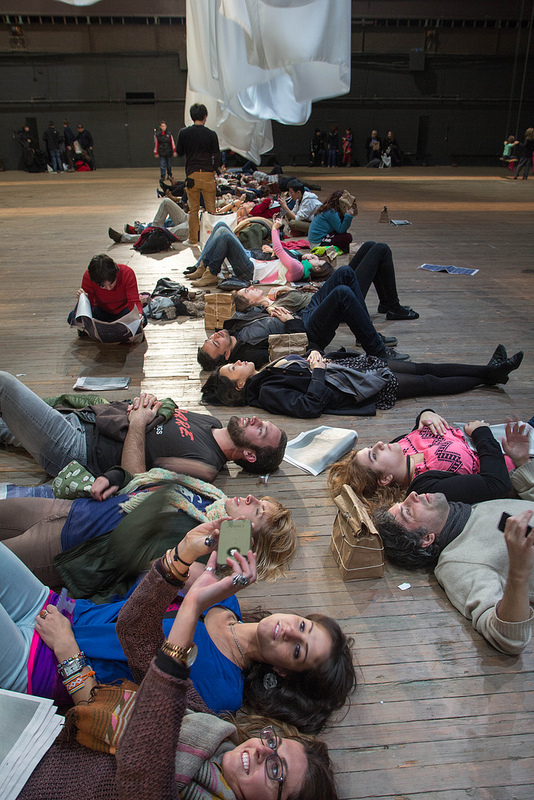
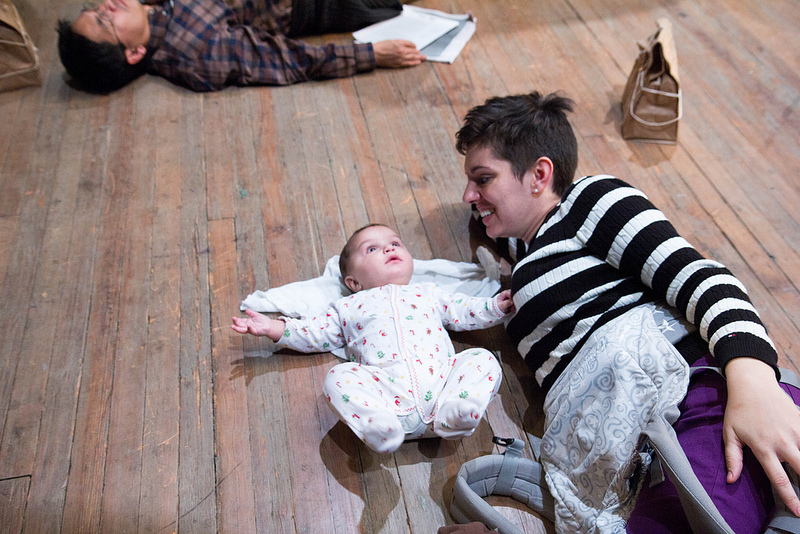
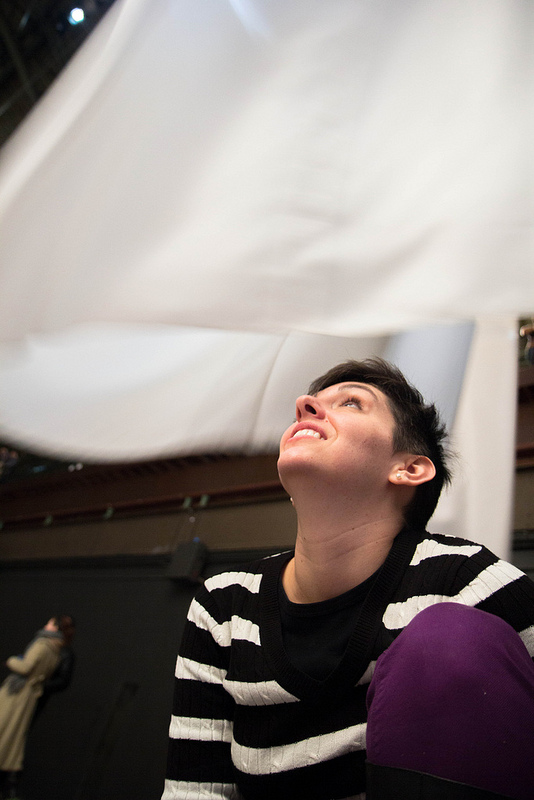
Last Saturday, K, Oliver, and I went to Ann Hamilton’s the event of a thread. It’s a tad hard to describe. Hopefully the pictures and video below will help.
the threadThere are speakers. In bags. Brilliant idea.Hanging under the curtainOliver is a big kid too, lying underneath the curtain.Mom and Oliver hang outWaiting for swings.

 There’s a joke in my clergy circle that people think all we do is sit around and pray all day. Of course, we don’t. We’re busy. We do things. We plan, write sermons, go to committee meetings, do, uh, things – we’re busy people. Oh. And we do pray…. occasionally.
 INAUGURAMA – Obama to be sworn in on MLK and Lincoln Bibles: The Presidential Inaugural Committee will announce today that on Mon., Jan. 21 — the 150th anniversary of the Emancipation Proclamation, and 50 years after the birth of the Civil Rights movement — President Obama will be sworn in using a Bible that belonged to Dr. Martin Luther King Jr. and the Lincoln Bible, which Obama used in 2009. At his official swearing-in on Sunday, the President will use the Robinson Family Bible, which belonged to the First Lady’s grandmother. On both days, Vice President Biden will use the Biden Family Bible, which he used each time he was sworn in as a U.S. Senator, and in 2009.
 So, today, I was told that I didn’t speak like I’m from around here.