Whose Pastor Are You?

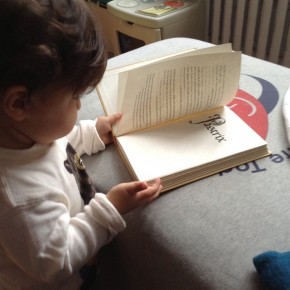
PastrixEven in the midst of Christmas services, supervisors and colleagues on vacation, and spending most of my days with O, I found time to finally ready Pastor Nadia Bolz-Weber’s Pastrix. Even O got into the act, taking it from me whenever he could. I really enjoyed it and I totally recommend it. I’m not going to review it, however. Instead, I want to bring something from her book and hurl it straight into my approval interview. In the first chapter, Nadia shares a story where she “realized that perhaps I was suppose to be their pastor.” It’s an awesome story about call, vocation, community, and identity. I also think it’s interesting when placed alongside one of the questions I was asked at my recent approval interview. The head of the candidacy committee asked me a very standard question: what kind of congregation do I see myself called to? The candidacy committee assumed I’m called to be a pastor to a specific community while Nadia’s description of call named that community. I already had an answer to the candidacy committee’s question but Nadia’s naming of her community is still lingering in my head. If my candidacy committee had asked me to name that community I feel called to be, I’m not sure I could have answered it on the fly.

The most straightforward answer is, of course, that I feel called to be a pastor to everyone. What I mean is that I feel called by God to be a pastor to people but not necessarily to be everyone’s personal, single, and only pastor. God knows my gifts and the needs that others have; I trust that the Holy Spirit will continue to match us as needed, helping me to grow in being a pastor in completely unexpected ways and helping those in need to find the spiritual and physical nourishment they need in whatever community they find themselves in. I’m called to be a pastor to everyone but not called to be everyone’s pastor, if that makes sense. And I think that’s a theologically solid point. The body of Christ is made up of a diverse multitude for a reason. Diversity isn’t something to fear in church; it’s necessary for the church to live out Christ’s love to a vast world.

So who, then, am I to pastor? If I had a magic wand, who would I draw up to exist in my church? I have a pretty creative and active imagination but I struggle mightily painting this image. I really wish I could point to a community, or a type of person and say, “oh yeah, that’s who I’m called to serve.” But I really can’t. I can point to situations, relationships, and times when I’ve been (and continue to be) someone’s pastor. I can point to kids, families, adults, singles, couples, young, old, and everything in between, as people who I have been pastor to and who see me as their pastor. I can point to relationship where I have been a temporary pastor, serving as a pastor to a person or family in a specific instance. I have been a pastor to people I will only ever see once and to people who I see every week and who call my supervisor “their pastor.” I can name people who have pulled me by my arms and told me, through the Holy Spirit, that I am called to be their pastor right then and now. And I have felt communities push me, headfirst, towards ordained ministry because they knew God was calling me to be there. I have felt the Holy Spirit moving in my sense of call and it is a powerful, wonderful, frightening, awesome, experience. But I can’t point to Nadia’s experience of call, at least as I understood it in her book. If my candidacy committee had ask me “whose pastor are you?” I don’t think I would have answered it as well as I want to. I can only point to who I have been a pastor to and how God keeps putting people and communities into my life in unexpected ways.

So when the candidacy committee asked me to describe the type of congregation, or ministry setting, I feel called to serve, I felt more comfortable describing an imagined community that already existed. But my answer left a lot of wiggle room. I focused focused on specific organizational cultural elements, identifying a small congregation with limited financial resources. I highlighted some cultural elements that might help (i.e. a desire to grow) but also knew that those cultural elements might not exist (or the exact opposite kind of cultural elements would stand in their place). I stuck with cultural organizational generalities because, to me, there’s an underlying and unnamed assumption that underpins my answer. I’m called to serve in a community that the Holy Spirit has, in some ways, already gathered (however loosely that can be defined). I’m not sure where that will be yet but I know it’s out there. I trust the Spirit to bring me there (and I pray it will be sooner rather than later – graduation is coming up!) The community will be filled with people I don’t know but who I will get to know and who I will love because that’s what I’m called to do. The community is there, I just can’t name it yet.


A Fair Weather Bear

Me and O in Coney Island

O and I went to Coney Island to help K do the polar bear plunge. We watched from the beach, behind the mass of humanity with cameras taking pictures of the mass of humanity that jumped into the water. K was in the water for about 30 seconds. She braved the below freezing weather in a bikini; I was covered in a down jacket filled with hand warmers. We ended the day with Corndogs and fries from Nathan’s. It was a successful start to 2014.

Mom Dad Moadd

O reading PastrixWith the seminary being mostly shut down due to Christmas (including O’s daycare), him and I have been enjoying some good bonding time since my work at Advent devoured my Christmas days and the followup can be done at night. I spend my days making sure O doesn’t totally destroy the house or lose his mittens outside and I spend my nights trying to cram too much work in too little time. Even with the major worship services done, the work of the church communications director continues.

O, over the last few days, has started to do something I didn’t expect. I’ll be carrying him up and down the stairs or hanging out with him on the living room couch, and he’ll start to talk. This isn’t unusual – he’s very talkative right now. I can tell he’s trying to string words together (mostly gibberish) and it seems he’s trying to sound out the English language. It’s neat. But one thing that’s really blown my mind is a pattern that he has come up with. He’ll first say “Mom,” then follow that up with “Dad,” and then create a new word, either “Mo-add” or “Da-dum.” He’ll then put these words into an order, going “Mom,” “Mo-add,” and then “Dad.” He’ll do this over and over again, mixing up the pattern and changing the middle word. He’s taking two words that we have used with him a million times, words that I know he knows, and combining them into something new. He’s playing a game, I think, and having fun with it. It’s really neat and I’m now trying to get him to do it with the names of the our pets. He knows “Chula” and he can say it. He’s struggling with “Twinkie” but he’s getting closer. Soon, I’ll hear nothing but “Chula, Twinkie Chu-linkie” all day long.

Links for December 26, 2013

Jumping over the subway

Jumping in the 145th Street Station | December 6, 2013 | gothamist

As Lutherans exit pew in Brooklyn Church, Arab Christians move in | A misleading headline; the church is a Lutheran church with a growing ministry to the Arabic speaking community in Brooklyn. Just because they’re not white and German doesn’t mean they aren’t Lutherans (or will be). | December 23, 2013 | New York Times

Comedian Aamer Rahman on Reverse Racism | Yep. | December 2, 2013 | The Hairpin

A Brooklyn Church Uncovers a Long Hidden Celestial Scene | December 25, 2013 | New York Times

Steve Harvey and President Obama surprise some White House tours | December 18, 2013 | People

This Chart Blows Up The Myth of the Welfare Queen | This month, the Bureau of Labor Statistics compared yearly spending between families that use public assistance programs, such as food stamps and Medicaid, and families that don’t. And surprise, surprise, households that rely on the safety net lead some pretty frugal lifestyles. On average, they spend $30,582 in a year, compared to $66,525 for families not on public assistance. Meanwhile, they spend a third less on food, half as much on housing, and 60 percent less on entertainment. | December 17, 2013 | The Atlantic

Peyton Manning RSVPs to a fan’s wedding | December 3, 2013 | First and Orange

Merry Christmas!

Merry Christmas one and all. May the Lord bless you and keep you tonight and forever.

O on the Close.

And when life gives you a stick, feel free to drop your football. That’s O’s motto and I can’t find anything wrong with it.

Inspiration

Peyton Manning

Peyton Manning does it all. Here he is icing his ankle, watching game film on an iPad, and listening to the plays being called on the practice field behind him. He’s probably also filming a Papa John’s commercial at the same time, writing the next rap battle with his brother, attending a parent teacher conference, solving world hunger, and throwing over 50 td passes a year. He is an inspiration to almost-clergy everywhere, especially those who are still trying to figure out how to be “on” while their toddler is in the room because I haven’t figured that out yet. That’s something, sadly, seminary doesn’t teach you.

Approved.

Approved!The rumors are true: I have been approved for ordained ministry in the ELCA.

I entered the Metropolitan New York Synod’s offices a tad nervous. I felt a bit like I did that first day, nearly four years ago, when I met the candidacy committee for the first time. There’s a few less hairs on my head than there were back then, I’ve gained a few pounds, and upgraded my suit and shoes in the process, but the butterflies in my stomach felt the same. You never know, really, what to expect when you meet the committee. Any question can be asked and nothing is off the table. In the build up to the meeting, all my irrational dreams filtered through my mind, all resembling that dream of arriving to take a surprise final exam that I didn’t study for. Would I be Lutheran enough? Would I be Christian enough? Would they just see through me? Did my cat send them some dirt ahead of time? I spent the evening prior reading the ELCA clergy guide, “Visions and Expectations,” but that didn’t calm my nerves any. Instead, I reverted to my high school routine when my nerves were besting me: I listened to the loudest pop punk I could find. I walked into the offices, chatted with another candidate for approval, and then was whisked away to meet four members of the candidacy committee in one of the drab conference rooms that dot the Synod’s office. Introductions were pleasant, a water pitcher was in front of us, a theme for the interview was set, and then the fun began. And I’ll be honest – I had a lot of fun.

The first question was a standard strengths/weaknesses/what-are-you-doing-to-change-your-weaknesses twelve part question. I took it in stride, making sure to mention anything that I accomplished in seminary and internship that was quantifiable. I didn’t only mention leading a Sunday School program; I mentioned how many students attended weekly. I could feel myself using tricks from my old web developer days, freely using “I” statements while throwing out specifics that could be backed up with data if necessary. And as the questions continued, covering pastoral care, theology, my internship experience, and my vision for where I might serve in the future, I could feel myself rolling through each question, each one feeding the next, and just energizing me forward. I didn’t have to pretend; I just talked. And the words, they came freely because I was doing what I love to do: talking about God’s actions in my life. Faith is just plain awesome and throwing down words about my love for Christ, God, and Lutheranism, were easy. It would be easy to just claim that this was the Holy Spirit working through me but this wasn’t just a one-time event. I was giving testimony how I’ve been formed and how the Holy Spirit was there even when I didn’t feel or know it. The words just came and I just had fun. The interview ran long because we were having too much fun. The committee would say “we’re getting low on time and we need to wrap up” and then two more questions would follow. This happened all the time. I loved it and the time just flew by. 50 minutes was the time limit but I think we blew by 75 before I even realized it.

At the end of the interview, I thanked everyone, checked in with other candidacy committee members, and then headed home to pick up the family, change my clothes, and head to church to sing Christmas carols outside in a snowstorm. I checked in with the staff, took care of some work, and served as a liaison between our senior pastor (who was at the candidacy committee meeting) and everyone on the ground at church. So, after my approval interview, I went to work. And I enjoyed it.

Later that evening, the head of the candidacy committee called me with my results. I was approved. I thanked him for his leadership and time with me, hung up the phone, and got a high five from my son and wife. Then I went out for a celebratory dinner where I ate a 20 oz burger and followed that up with a Christmas party on the seminary campus. Happy and exhausted, I hit the hay way too late, got up the next morning, and headed back to work. I couldn’t imagine it any other way.

But there has been one thing I didn’t expect through this whole process: I didn’t expect to feel different now that I am approved. But I do. Maybe it is because I can now worry about finding a job rather than approval (and the finding a job thing is going to be a hot mess) that makes my life feel different. I feel like there’s one thing in the back of my mind that has melted away. And that melting has made life just a tad different. I went through my emails and found my first email to the assistant to the bishop in charge of formation, asking about candidacy. It was dated September 15, 2009. Now, 4 years later, here I am. Who knew this would happen? Well, God did, but not me. And here I am, with only one more semester left in seminary. Thanks be to God.