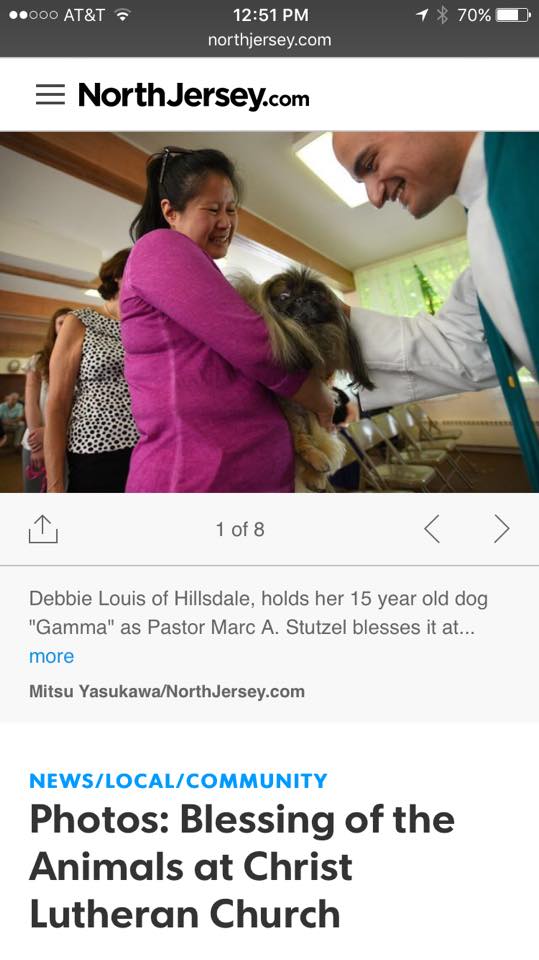
I bless animals the last Sunday in June. Today, the Bergen Record stopped by. Click to view some pictures!
I bless animals the last Sunday in June. Today, the Bergen Record stopped by. Click to view some pictures!
What then are we to say? Should we continue in sin in order that grace may abound? By no means! How can we who died to sin go on living in it? Do you not know that all of us who have been baptized into Christ Jesus were baptized into his death? Therefore we have been buried with him by baptism into death, so that, just as Christ was raised from the dead by the glory of the Father, so we too might walk in newness of life. For if we have been united with him in a death like his, we will certainly be united with him in a resurrection like his. We know that our old self was crucified with him so that the body of sin might be destroyed, and we might no longer be enslaved to sin. For whoever has died is freed from sin. But if we have died with Christ, we believe that we will also live with him. We know that Christ, being raised from the dead, will never die again; death no longer has dominion over him. The death he died, he died to sin, once for all; but the life he lives, he lives to God. So you also must consider yourselves dead to sin and alive to God in Christ Jesus.
Romans 6:1-11
My sermon from 3rd Sunday after Pentecost (June 25, 2017) on Romans 6:1-11. Listen to the recording at the bottom of the page or read my manuscript below.
****************************
On Wednesday, my cat Finn started to act strangely. Now, I haven’t had Finn for a while and he’s still, technically, a kitten. He’s still developing his normal rhythm of life and I’m still figuring out who he is. But on Wednesday, I knew something was slightly off. He wasn’t in pain or meowing or not eating. He still playfully lashed out at anyone’s feet when they walked by. But something was different and we were concerned. So I did what I always do when a healthcare issue shows up in my life. I googled it. As a child of the internet, looking up things online is….just what I do. When I get a slight cold, I google the symptoms. When my kids ask a question about the world, I flip open my phone. So when Finn started to act strangely, I did what I always do: I looked for a solution. I tried to get a sense of what was going on. And everything I read told me to take him to the vet. So that’s what I did. And now we’re trying to force feed liquid antibiotics to a cat, which is just as easy as it sounds. On Wednesday, I had a problem. My furry family and I sought a solution. The internet helped us use a wide variety of sources to find a way to deal with this situation in our lives. And this approach to problem solving is not too different from what the community in Rome was doing when Paul’s letter first arrived.
Now, we don’t know much about the early Christian community in Rome. We don’t know who brought them them gospel or how many different people taught them about Jesus. But we do know the community was mostly made up of Gentiles, of non-Jews, who probably felt like the normal Roman way of life wasn’t giving them all they needed. Instead, they sought a new way to deal with their problems and that led them to a Jewish way of life. During Jesus’ day, the Jewish faith was growing. There were Romans who believed in God. They found meaning and value in practicing the Jewish food laws, in worshiping God, and saw in the Bible tricks and tips to help them manage their lives. The Jewish way of life, an approach to living modeled by Jesus himself since he is Jewish, was that outside source of information that seemed to solve a problem these Romans had. And that problems was the passions.
So what are the passions? We usually identify them as emotions, appetites, and feelings. We might give them names like lust or sorrow, anxiety or fear. Passions are the feelings and experiences that make us feel as if we are getting in our own way when it comes to living our authentic lives. And in ancient-Greco Roman thought, personal suffering was rooted in these passions. One of the goals of life, then, is to, somehow, master these passions. Instead of being controlled by lust, we tame it. Instead of letting melancholy keep us in sorrows, we overcome it. In a very mind over matter kind of way, living well means developing habits that turn us into being an active participant in all areas of our life. Now we have to step back and realize that this kind of living was only available to a select few. If you were a slave, you couldn’t do this because you didn’t have the agency or the independence to stop anyone from acting on you. And if you were a woman, the patriarchy and wider culture already saw you as weak and it was assumed you would never master human nature. Yet, overall, this idea about mastering the passions was a cultural ideal that impacted all areas of life. Living well, then, was a kind of dying. Life was about doing the hard work necessary to kill off these passions that dominate us. And for some Romans, the Jewish way of life seemed to provide a way to tame these passions. By following the rules, ethics, and behaviors taught in the Books of Moses and modeled by the lives of David and the prophets, the good life – as Roman culture defined it – could be reached. Part of the appeal of Judaism, including this Jesus-based sect inside the city of Rome, were these rules for life that this faith offered. Jesus himself seemed to offer a way to master the passions. But this early Roman community also thought something else. They imagined that mastering their passions was the only way they could make themselves acceptable to God. It was almost as if following Jesus was some kind of self-help program that, once completed, would give them a gold star on their report card from God. And without that gold star, without proving their own worth and value, God would shut them out. This is a type of Christian faith that acts as if we have the power to somehow convince God to fall in love with us. We can, with the right program or habits or life hacks or by entering the right search words into google, we can learn the tricks we need to do to secure our relationship with God. This way of thinking believes that our hope for finding meaning and value in our lives depends only on us. And Paul calls this way of thinking, this way of living, sin. Because the story of Jesus doesn’t show us the tricks we need to do to somehow convince God to finally care about us. The story of Jesus is about a God who loves us so much, that even death itself can’t separate us from God. Life isn’t about dying to our passions. Life with Christ is realizing how, through our baptism, we’ve already died. The old self that tries to chase after God is missing the fact that God already has us. The sin that thinks we can somehow fix our relationship with God is stopping us from seeing how Jesus has already done that work. As followers of Jesus, we’re more than just human beings. We’re more than just a bucket full of appetites, emotions, and feelings. We are the body of Christ. We are part of Jesus. And that’s means you are a beloved child of God – and that changes everything.
I don’t think Paul would have disliked using Google to find out what’s wrong with a cat. Nor do I think he would have been against us trying to figure out how we can better ourselves. When it comes to being more fully who we are, God has given us so many ways to find health and wholeness. Counselors and therapists, life coaches and spiritual directors, are not to be shunned nor are we to consider people who use them as somehow worth less than us. The stigma against mental illness and seeking help is something every Christian is called to fight against. Everyone should have the health resources they need to seek help when they need it and not feel like the church or society or even God will think less of them. The journey of self-betterment can help us grow into being who God calls us to be. But there is nothing we can do to make God love us more. And our journey towards becoming better versions of ourselves starts with what Jesus has already done. Jesus has already died for you. Jesus has already called you as part of God’s holy family. You’re already worth more than you can possibly know.
So life isn’t about chasing after God. Life is about living and knowing that God already has us.
Amen.

Podcast: Play in new window | Download
This is the second week in a row when the gospel reading (Matthew 10:24-39) mentioned families. Last week on Father’s Day, brothers, fathers, and children turned against each other. This week, daughters are turning against mothers and mother-in-laws. The two readings are from Jesus’ instruction to his disciples before he sends them to do his work. Jesus tells his followers that this journey will not be easy. Jesus’ followers will not always be welcomed and loved. The message they are bringing will challenge and confuse the wider Greco-Roman culture. There’s something about Jesus changes the bonds we have with each other. And sometimes, the bonds inside our own families will break.
This message doesn’t seem to jive with the message we also hear in Jesus’ words today. Jesus tells his followers that God cherishes them. God knows each of them in a real and authentic way. These words are filled with a theme of inclusion and welcome. Through their relationship with Jesus, the disciples are brought into a new family. This family is centered around a Jesus who will live and die for each of them. The people included in this Jesus-generated family are not perfect. Nor can each individual invite themselves into this group. Instead, Jesus calls them by name and loves them because that’s what God does. God is creating a new family while the bonds of other families fall apart.
We have many examples in our lives of broken families. Entire communities know what it’s like to be abandoned. Too many friends of mine have been kicked out of their families for coming out as LGBT. Others have watched as broken promises, abuse, and addiction have destroyed the trust and love we believe all families should practice. When Matthew wrote down these words from Jesus around the year 75 C.E. (A.D.), the Christian community was very small. New converts to the faith were sometimes disowned by their families and friends. The experience Jesus described here is an experience the author of Matthew knew well. It’s also an experience that is still too common today. Yet Jesus’ word promises a new family that has, at its center, someone who will never break a promise of fidelity, love, and trust. This family is centered around someone who doesn’t call the perfect to be his friends. He doesn’t leave space at the table for only those who act and think and look like he does. Jesus points to a bond and love from God that transcends the bonds of human family. And this bond, even when threatened with the Cross, will not be broken.
Each week, I write a reflection on one of our scripture readings for the week. This is from Christ Lutheran Church’s Worship Bulletin for 3rd Sunday After Pentecost, 6/25/2017.
‘Do not let your hearts be troubled. Believe in God, believe also in me. In my Father’s house there are many dwelling-places. If it were not so, would I have told you that I go to prepare a place for you? And if I go and prepare a place for you, I will come again and will take you to myself, so that where I am, there you may be also. And you know the way to the place where I am going.’ Thomas said to him, ‘Lord, we do not know where you are going. How can we know the way?’ Jesus said to him, ‘I am the way, and the truth, and the life. No one comes to the Father except through me.
John 14:1-6
I’ve never shared a funeral reflection in a living room before. Usually, when I’m sharing these kinds of thoughts, I’m in a funeral home or at a church or standing next to a grave. I’m not usually preaching in a space like this. But I’m glad I am because this space….is filled with Dorothy. This is the building where she spent her nights. This is the town she called home. And this is the place where she created memories with you – memories she cherished and memories you will carry with you forever. We are in a place where Dorothy did a lot of living. And we should be here. We should be sharing our memories of her, here. We should be telling each other our joys and our sorrows, here. We should, ina sense, live in this space like she did. By sharing even these sad moments together, we are making this space a real living room. So It’s good for us to be here. It’s good for us to share how Dorothy made a difference in our lives. And it’s important that Robert and Jean picked this gospel reading from John. Because, in our reading, Jesus is also in a room filled with people who loved him. They had done a lot of living together. So Jesus makes a promise to his friends and to us – the living and love we share will continue, no matter what.
Today’s reading from John is the start of Jesus’ Farewell discourse. It’s called that because that’s exactly what is. It’s sort of like John’s version of the last supper. Jesus and his friends are in a room. They shared a large meal together. They’re starting to get comfortable and they’re wondering what’s going to happen next. But before they could decide what to do, Jesus does something unexpected. He washes their feet. Now, this action confuses Jesus’ friends because, in their world, only slaves wash people’s feet. Jesus, as their teacher and leader isn’t supposed to act like a slave. He isn’t supposed to serve in this way. But Jesus does. And then he keeps serving them by launching into a long speech that lasts 3 whole chapters. Because, in the gospel according to John, Jesus is always in control. He’s always one step ahead of his friends and his enemies. Jesus knows how his life, and his death, will play out. But he also knows that the disciples aren’t him. They have a vision of the future that doesn’t match what God is about to do. So – Jesus talks. He uses his words to say farewell but he isn’t saying goodbye. He’s promising his friends that the love they share, this relationship that binds them together, won’t be broken by what comes next. The death Jesus experiences – a death his friends will see and feel – won’t be the final word. There’s so much more in store for all of them.
So the discourse begins with this image of a giant building full of many rooms. We’re using an older translation of the Bible today so the words house and mansions brings to mind big giant spaces, like those new homes developers build on Ridge Road or by the high school when they tear down older homes and build something gigantic to replace it. But a better translation of our reading today wouldn’t include the words mansions or rooms. It would instead say dwelling places. Jesus isn’t building a castle in heaven full of palaces that his followers can live in. Jesus is telling those who know him, those whom he has called by name, that what matters most is the relationship he has with them. What’s important is how much he cares and loves them. And since love and care are verbs, the word mansion or house isn’t enough. Instead, we need dwelling places because dwelling places are lived in. They’re the kind of places where the dishes in the sink might stay an extra day because company is over and the conversation about the most recent book we’ve read is just too good to break away from. A dwelling place is filled with memories and laughter, joys and even tears. A dwelling place, in other words, is a living room where stories are created and shared and is a place where God’s promise of life and love, in the end, conquers all.
Dorothy, from what you all have shared, lived. This place was truly her dwelling place, her living room. The way she lived will continue to ripple outwards, through the memories you share, and into the new memories you create in the living rooms of your own. We are blessed because Dorothy blessed us. We are blessed because Dorothy loved. And we know that everything that made Dorothy who she is – is now basking in the eternal light of our glorious Lord, forever and ever.
Amen.
A sermon on John 14:1-6 at a memorial service held in a living room on 6/17/2017.
Jesus’ ministry and the church takes work and workers. This is one of the take aways from our reading in Matthew 9:35-10:23 today. At this point in Jesus’ career, Jesus is doing what Jesus does. He preaches, teaches, and heals. He shares a vision of God’s kingdom that includes tax collectors and others typically kicked out of holy places. He eats meals with people he shouldn’t. Jesus is being Jesus. And Jesus, in our verses today, compels his followers to do the same.
The apostles’ mission is an outgrowth of Jesus’ own ministry. Jesus visits new places and tells his followers to do the same. Jesus tells his followers to share God’s message of love and hope using the same words he uses. Jesus’ followers are called to cure the sick, raise the dead, cleanse lepers, and cast out demons. And Jesus’ followers are told to provide this physical and spiritual care for free. A follower of Jesus doesn’t act only to benefit themselves. They are told to give freely and abundantly because that’s what Jesus does too. In the words of Colin Yuckman of Duke Divinity School, “To be sent by Jesus is, in some sense, to be sent as Jesus.” Jesus is training his followers on how they can be his disciples. When people encounter us, they are encountering and experiencing Jesus Christ and we need to act accordingly.
This encounter with Jesus Christ is an unexpected mission God invites us to share. It’s also a mission that is not easy to do. An invitation to follow Jesus is an invitation to live a different way. An invitation to live in God’s kingdom means we need to realize the hard truths about the brokenness of the world around us. An invitation to live as Jesus is an invitation to recognize the ways we push ourselves and others away from God. Jesus decides that people like us can, through the help of the Holy Spirit, show others Jesus Christ. This seems like a daunting task. It can make us feel afraid. But, like we heard last week, we don’t do this job alone because Jesus is with us to the end of the age.
Each week, I write a reflection on one of our scripture readings for the week. This is from Christ Lutheran Church’s Worship Bulletin for 2nd Sunday After Pentecost, 6/18/2017.
Therefore, since we are justified by faith, we have peace with God through our Lord Jesus Christ, through whom we have obtained access to this grace in which we stand; and we boast in our hope of sharing the glory of God. And not only that, but we also boast in our sufferings, knowing that suffering produces endurance, and endurance produces character, and character produces hope, and hope does not disappoint us, because God’s love has been poured into our hearts through the Holy Spirit that has been given to us.
For while we were still weak, at the right time Christ died for the ungodly. Indeed, rarely will anyone die for a righteous person—though perhaps for a good person someone might actually dare to die. But God proves his love for us in that while we still were sinners Christ died for us.
Romans 5:1-8
My sermon from 2nd Sunday after Pentecost (June 18, 2017) on Romans 5:1-80. Listen to the recording at the bottom of the page or read my manuscript below.
****************************
Yesterday, around noon, I was sitting at my dining room table, putting the finishing touches on a funeral sermon I would share a few hours later. When I was done, I gathered my things and headed out the door. And that’s when I noticed…the rain. By the time I was halfway down the block, it was pouring. This..wasn’t good because the funeral service I was about to lead was taking place outdoors in our Memorial Garden. When I finally got to church, I stood in the narthex, looked out the front doors, and did all I could to make the rain stop. I said a prayer. I stared intently at the sky, hoping the seriousness of my face would convince the clouds to back off for a little bit. But nothing I did worked. The rain kept falling. I then decided to move the service inside, hoping we could by some time, and give the skies another 15 minutes to clear out before we would bury ashes in the ground. We started the service, read the lessons, said our prayers, and the rain kept falling. Now I know it’s a bit presumptuous to act like yesterday’s rainstorm was specifically designed to interfere with what I wanted to do. But the rain came at the exact right time to upend the plans I made. If the clouds had stayed away for just one more hour, the service would have gone on without a hitch. But instead, the right time for the funeral was also the right time for the rain to fall.
Our reading today from the book of Romans mentions this…idea of the right time. Now, we call Romans the book of Romans but it’s really a letter. Paul is writing to a group of people in the city of Rome who believe in Jesus. We don’t know when this community was founded or who was first to bring Jesus there. Yet by the time Paul is planting churches all over the Eastern Mediterranean, a church in Rome had already been formed. Paul is hoping to visit this community and he introduces himself with a very long letter. The community in Rome seems to have some…concerns about who Paul is and what he’s teaching. They want to know more about what the gospel means to him. We sometimes make this long letter to the Romans seem like it’s Paul’s great attempt to put all his experiences of Jesus and faith and the church into a neat, cohesive, and coherent package that should be easy to understand. But I don’t think that’s Paul’s goal. He’s not trying to talk about Jesus as if Jesus is…some kind of fancy thought experiment, something we only have to keep in our heads. Paul isn’t hoping that the community in Rome will hear his words and then start nodding their heads in agreement. Instead, Paul is trying make Jesus happen to them. He’s trying to convey an experience that touches the core of all who hear it. Paul, using the only thing he has at that moment to share Jesus, uses a scroll and a pen to plant seeds of faith in those who hear it. And this faith doesn’t start by understanding an idea or a concept. This faith begins with a promise. In Christ, God has claimed you. In Christ, God has shown how much God loves you. In Christ, you are given a gift of faith that’s always in awe because the creator of everything has decided that this is the right time for you to know how much you matter. And you matter not because you are perfect or because you always do the right thing. You matter because God has created you. And that’s…enough. In a society that still makes up rules about who has value and who does not, God promises that even those society views as valueless are seen and noticed by God. The values of our society and of our culture are not the limit to the values God has. Everyone’s value is grounded in the relationship God starts with them and not the other way around. This promise God makes is a promise of hope. Because when your hope is rooted in God, it’s a hope no one can take away from you.
What Paul is doing in these short verses from Romans is to invite the community to live that promise out loud. This hope-filled promise begins in a God who sees them, knows them, values them, and won’t leave them on their own. This kind of hope isn’t wishful thinking or one that is so abstract and heady that we leave it out there, on the horizon, knowing we’ll never see if fulfilled so it never inspires us to live a different way. The hope that Paul sees is certain and sure and true. And it’s hope that knows God acts. In the words of Elizabeth Shively, “what God will do for the believer in Christ is grounded on what God has done.” God didn’t wait for us to be perfect before Jesus visited us. Jesus didn’t wait for us to understand everything he said before Jesus claimed us as his own. The God who acts is a God who doesn’t wait for us to catch-up. Instead, the God who acts is a God who comes to us first. Because the right time for God to meet us is always at our beginning. And God keeps coming to us over and over again because we need a lot of new beginnings. We need God to give us new eyes to see the world as it truly is. We need God to give us new hearts so we can love each other as much as God loves us. We need God to break the bonds of injustice that keep systems of oppression firmly in control. And we need God to keep giving us this hope that the God who has acted in Jesus won’t let upended plans get in the way of what God is about to do.
For people who are claimed by God, the trick to living your faith out loud isn’t trying to wait for the right time or right situation or right feeling to hit you before you start living. The trick is to always live in God’s love and hope and promise – even when the rain of sorrows, anxieties, fears, and hardships fall. Faith doesn’t mean that sorrows won’t come. Faith doesn’t mean that we never will be anxious. Instead, faith means that in spite of what comes, we live and act and believe that the future God has planned will actually come. And faith trusts this because Jesus has already come. Jesus has already called you by name. And once Jesus knows you, there’s nothing in this world that can push that promise away.
Amen.
Podcast: Play in new window | Download
Imagine, after a super busy week, being confident enough to take a break. And if God rests, why can’t we?
Our first reading today (Genesis 1:1-2:4) is the opening to our Bible. These verses share with us the first creation story in our scriptures and how God created in seven days. The universe began as a formless void. God, in this story, doesn’t create out of nothing. Instead, God brings order to a chaotic soup of randomness. For six days, God creates. Animals, birds, plants, and people are formed. I love how the giant sea monsters are named specifically in this story and how humankind begins their lives as vegetarians. The opening words of the bible are not meant to be a timeline detailing the history of the universe. Rather, these verse show God’s relationship with everything. Unlike other creation stories floating around during the time of ancient Israel, the world isn’t created through a violent act. There is no war between various gods that caused the earth to come into being. The world, instead, is created by a God who declares that creation is good. Everything within creation matters because God says it does. The sea monsters and the blades of grass are connected to a God who loves them.
So after creating everything, God took a break. God, for a brief period of time, stops working. In our modern context, we are used to the idea of weekends. We live in a society shaped by over a century of people, systems of thoughts, organizations, and labor unions that created the weekend. In a sense, the weekend is an ideal. We take a break from a normal workweek to instead, rest. This is an ideal because not everyone’s work week begins on Monday and ends on Friday. And our lives are so dedicated to busy, we stop working on Fridays only to start again with other projects, sports games, homework, and more on Saturday. We work because we have to. We keep working because, if we don’t, we imagine what we’re doing will never get done. We’ve built lives where we need to be busy because we don’t receive the help we need to take a break. We are, in the words of some, a society addicted to being busy.
But God, who doesn’t need to take a break, actually stops working. God rests. God, who has a relationship with every blade of grass, every sea monster, and every person, has created a world where taking a break matters. God invites us to live in a world where everyone has the time and resources they need to stop doing everything. Instead, we can sit, enjoy, and bless each other and the world. When we take a break and help the people around us take a break, we’re not encouraging laziness. We’re encouraging people to connect with creation and the God who created it. And when we can connect with God, we discover how we can bless what God has blessed. And we discover the blessing God wants us to be.
Each week, I write a reflection on one of our scripture readings for the week. This is from Christ Lutheran Church’s Worship Bulletin for Trinity, 6/11/2017.
When you picture the Holy Spirit, what do you think of? Unlike Jesus, the Holy Spirit has no physical form. The Holy Spirit is not something we can touch or objectively see. Even though the gospels describe the Spirit of God in the form of a dove, the dove is merely a metaphor. The metaphor describes what the Holy Spirit is like but the metaphor shouldn’t limit what the Spirit can do. For centuries, the translation of Holy Spirit as Holy Ghost misidentified what the Spirit can do. We know ghosts. Ghosts go by the name of Casper. They are something we see in a horror film. They can walk through walls, vanish in an instant, and help us make pottery when we star in a Patrick Swayze film. But because ghosts are recognizable, they seem containable in some way. The Holy Spirit, as depicted in scripture, is the opposite. The Holy Spirit, as we see in our reading from Acts today, is not contained by anything. Like the cry of a dove across a large valley or a rush of wind blowing through a small room, the Holy Spirit moves, breaking the ways we keep to ourselves and forcing us out of our self-imposed containment.
Pentecost (Acts 2:1-21) is sometimes described as the “birthday” of the church. That’s a metaphor that’s not quite right. The church is always the community of believers who proclaim Jesus Christ, crucified and risen from the dead. This new kind of community began the moment Mary and other women told their friends that Jesus was raised from the tomb. Pentecost is really a celebration of the different kinds of people God is calling into this new kind of community. The city of Jerusalem is filled with Jews from all over the world. These pilgrims speak many different languages and have many different nationalities. The Holy Spirit gives the apostles the ability to make Christ’s story heard in many different languages. The miracle of Pentecost is not the apostles’ ability to speak different languages. The miracle of Pentecost is God calling many different kinds of people to be part of this new community because Jesus’ message of hope, reconciliation, and love is for everyone.
Each week, I write a reflection on one of our scripture readings for the week. This is from Christ Lutheran Church’s Worship Bulletin for Pentecost, 6/04/2017.
When the day of Pentecost had come, [the apostles’] were all together in one place. And suddenly from heaven there came a sound like the rush of a violent wind, and it filled the entire house where they were sitting. Divided tongues, as of fire, appeared among them, and a tongue rested on each of them. All of them were filled with the Holy Spirit and began to speak in other languages, as the Spirit gave them ability.
Now there were devout Jews from every nation under heaven living in Jerusalem. And at this sound the crowd gathered and was bewildered, because each one heard them speaking in the native language of each. Amazed and astonished, they asked, “Are not all these who are speaking Galileans? And how is it that we hear, each of us, in our own native language? Parthians, Medes, Elamites, and residents of Mesopotamia, Judea and Cappadocia, Pontus and Asia, Phrygia and Pamphylia, Egypt and the parts of Libya belonging to Cyrene, and visitors from Rome, both Jews and proselytes, Cretans and Arabs—in our own languages we hear them speaking about God’s deeds of power.” All were amazed and perplexed, saying to one another, “What does this mean?” But others sneered and said, “They are filled with new wine.”
But Peter, standing with the eleven, raised his voice and addressed them, “Men of Judea and all who live in Jerusalem, let this be known to you, and listen to what I say. Indeed, these are not drunk, as you suppose, for it is only nine o’clock in the morning. No, this is what was spoken through the prophet Joel: ‘In the last days it will be, God declares, that I will pour out my Spirit upon all flesh, and your sons and your daughters shall prophesy, and your young men shall see visions, and your old men shall dream dreams. Even upon my slaves, both men and women, in those days I will pour out my Spirit; and they shall prophesy. And I will show portents in the heaven above and signs on the earth below, blood, and fire, and smoky mist. The sun shall be turned to darkness and the moon to blood, before the coming of the Lord’s great and glorious day. Then everyone who calls on the name of the Lord shall be saved.’
Acts 2:1-21
My sermon from Pentecost (June 4, 2017) on Acts 2:1-21. Listen to the recording at the bottom of the page or read my manuscript below.
****************************
What do you do when you see storm clouds moving towards you? That question has been on my mind since Wednesday night, after I spotted a thunderstorm south of here. I had just left a church meeting and was busy trying to convince my four year old and two year old that staying in their car seats was actually a good idea, when someone pointed out bright flashes lighting up the southern sky. As we looked through the tops of trees, we could see bolts of lightning flashing from cloud to cloud. We couldn’t hear any thunder. And I don’t recall any gusts of wind. But I do remember staring intently at those storm clouds as they moved from west to east. As I put my two kids in their car seats, and I said goodnight to those who attended that church meeting, I kept my eyes turned south. I wanted to know where the storm was going and if I needed to rush home to close some windows before the rain came. But as I stared at that storm, I realized I was also looking for something else. Even though it was dark and the flashes of lightning were the only thing illuminating the storm itself, my eyes were trying to see what the clouds themselves were doing. I strained my eyes trying to see if the clouds were rotating. Regardless of where I am or what time of day it is or even whether the clouds are bringing rain or snow, the first thing I do when I see a storm is to look for clouds rotating around each other. As a kid growing up where the Rocky Mountains met the Great Plains of the midwest, violent winds were just a part of life. During the school year, instead of lock down drills, we had tornado drills. I remember learning how to go into the hallways of my elementary school, kneeling down on the floor, and covering my head and neck. I watched countless cheesy made-for-school movies about what happens to a house when a tornado comes and how the wind announces itself by sounding like a freight train. When a violent wind comes, we were taught to never go towards it. If we were caught outside and couldn’t get into a basement, we were told to run into a ditch and cover our head. We learned how it’s safer to run and hide than trying to outrun a tornado in a car. Violents winds are scary. Violent winds are not something were called to confront. When a violent wind comes, like a tornado or a hurricane or a superstorm, we’re told to find someplace safe. We’re told to protect ourselves. We’re told to stay away. Which is why, when it comes to our reading from the book of Acts today, I wonder: why didn’t the disciples run? When the wind began to blow, when the curtains and doors started to shake, when the wind blew out the candles and knocked papers and dishes onto the floor, when the entire house itself shook – why did they stay? And why did the Spirit of God come to them in this frightening, terrifying, and completely disruptive way?
We have a tendency in the wider church to make the Spirit….safe. We cling to images of the Spirit as a dove, as a little white and fluffy bird. The bird is perfect, without blemish, a bird we think is beautiful enough to have been sent out from the Ark by Noah and to announce who Jesus is at His baptism. And when the bird moves, it never really seems to flap its wings. It just seems to float and glide, as if it fell off a cloud in heaven, caught a bit of an updraft, and is taking it’s time to, ever so gently, come down to earth. When this dove finally lands, making itself known to us, this Spirit doesn’t land with a thud. Instead, we imagine it landing on us with grace and gentleness and comfort, like a feather floating from heaven. This image of the Spirit is very calming. It’s peaceful. It’s comforting because it doesn’t really challenge us. A dove doesn’t ask us to do much. A dove is soft and cuddly and doesn’t disrupt the world around us. A dove invites us in a gentle way to be a little more holy, a little more Christ like, and to share Jesus in whatever way we find comfortable. A dove….isn’t a violent wind. A dove doesn’t shake an entire house. A dove doesn’t knock everything onto the floor, making a mess of everything we set-up and planned for. And a dove doesn’t immediately cause us to go out into the street and start babbling in languages that only immigrants and foreigners and non-citizens understand.
Keeping the Spirit as a dove is safe. Keeping the Spirit as a dove keeps us from seeing what the Spirit does. We don’t want to imagine God’s Spirit literally blowing us out the front door, out of our comfort zones, moving us away from everything we know and love and that keeps us safe until we suddenly find ourselves face to face with people who aren’t like us, who don’t believe like us, but who God has put in our path to know, and to love, and to share Jesus with. When we keep the Spirit locked into the image of a dove, the Spirit stays small, contained, and feels like it’s only designed for me, myself, and I. But when we let the Spirit be the Spirit, we recognize how God’s Spirit shakes our homes, upending the order and stability we built for ourselves, forcing us to do uncomfortable, scary, and even mind-boggling things – all for this wacky thing we call faith. When we let the Spirit be the Spirit, we recognize how the Spirit isn’t only a thing or a force or a wind or some abstract metaphysical concept designed by pastors to confuse and confound Confirmands (like Connor, Josette, and Brendan). The Spirit, at its core, is a promise – a promise that God made to each of us. When God first met us, God made a promise to know us. When Jesus first called us by our name, he made a promise to be with us, no matter what. And when the Spirit was first breathed into us, the Spirit of God, the Spirit of Jesus, the presence of everything holy and divine was wrapped around us, tight. Right now, the mighty wind that shook the apostles’ house is the same Spirit shaking you. The Spirit that makes old men dream dreams is the same Spirit inviting you into the dreams God has for each of you. The Spirit is not abstract. The Spirit is more than a dove. The Spirit is the promise that you have value; that you have worth; and that a world filled with different kind of people from different kinds of places, from Mesopotamia to Cappadocia, from Rome to Arabia, is not a world where God’s love is reserved for a select few. Rather, the Spirit that holds you is the same Spirit that is moving you to help others discover a new vision of love and hope and to dream dreams of safety and peace. In a world where the violent winds of hate and fear, of climate change and terror, of sin and war, cast a long and dark cloud over everyone, the promise that holds you tight is that no wind or evil or even death itself can blow Jesus’ love and care away from you. When the storm clouds come, when they twist and twirl and rotate around you, cling to the promise that the Spirit is with you, the Spirit is acting through you, and that God’s love cannot be torn away from you. The storms in your life, no matter how strong, will not win because the Spirit of God, the Spirit of Jesus, the Spirit of the Holy Trinity, will carry you through.
Amen.
Podcast: Play in new window | Download